
Before I connect to a campground’s city-water supply, I recommend checking how your RV’s plumbing will be protected. A Motorhome Water Pressure Regulator limits incoming pressure, helping reduce the risk of pressure-related leaks. I recommend connecting it directly to the campground spigot, before your drinking-water hose, to protect both the hose and downstream plumbing.
For the pressure setting, I follow the motorhome manufacturer’s guidance—not the campground’s supply pressure. While 40–50 psi is a common RV operating range, it isn’t safe for every setup. Your owner’s manual and the pressure limits of every connected component should determine your setting.
I also make an important distinction: a regulator controls pressure; it doesn’t filter water, prevent freezing, or boost a weak campground supply. In this guide, I’ll explain what to look for when buying one, how to install it, and how to distinguish a pressure problem from restricted water flow.

What Does a Motorhome Water Pressure Regulator Do?
A water pressure regulator reduces higher inlet pressure to a controlled downstream pressure. Most RV models use a spring-loaded valve that responds to pressure changes as faucets open and close.
Think of it as a gatekeeper, not a water pump. It limits incoming pressure but cannot raise a weak water supply above the available inlet pressure.
Three terms matter when you choose and use one:
- Pressure, measured in psi: The force exerted by the water.
- Flow, measured in gallons per minute (gpm): The amount of water delivered over time.
- Pressure loss: The reduction in pressure as water moves through hoses, filters, valves, and fittings.
A shower can have poor flow even when a gauge shows normal pressure with every faucet closed. A clogged filter or narrow fitting may restrict water once a faucet opens.
Is a regulator the same as a flow restrictor?
No. A pressure regulator controls downstream pressure within its operating limits. A simple flow restrictor limits how much water passes through an opening.
Do not judge a regulator by its shape alone. Check whether its documentation specifies regulated outlet pressure, maximum inlet pressure, and flow performance.
Does every motorhome need an external regulator?
Check whether your motorhome has a factory-installed pressure regulator. A city-water connection or check valve does not, by itself, confirm that pressure regulation is built in.
Even when an onboard regulator protects the RV, an external regulator at the spigot can protect the supply hose and equipment ahead of the onboard unit. Confirm that using both does not create an unacceptable flow restriction.
What Pressure Should You Set for a Motorhome?
Use the operating pressure specified by the motorhome manufacturer, while staying within every connected component’s limits. Do not use a hose’s burst-pressure rating or a plumbing test pressure as the normal operating setting.
Check these limits before you adjust anything:
| Item | What to verify | Why it matters |
|---|---|---|
| Motorhome | Recommended city-water pressure and maximum permitted pressure | Establishes the RV’s operating limits |
| Regulator | Adjustment range and maximum inlet pressure | Confirms that the regulator suits the supply |
| Drinking-water hose | Working-pressure rating and temperature limits | Protects the connection from the spigot |
| Filter and housing | Working-pressure rating and installation instructions | Prevents damage to the treatment system |
| Added fittings or equipment | Any lower pressure limit | Identifies the weakest connected component |
Stay below the lowest applicable limit. If the manual gives only a maximum pressure, do not assume that the maximum is the preferred setting.
Static pressure versus flowing pressure
Static pressure is measured when no water is moving. Flowing pressure is measured while a faucet or other fixture is running.
Both readings help, but they answer different questions:
- Static pressure helps reveal excessive resting pressure or a regulator that does not hold its setting.
- Flowing pressure shows how the system performs under demand.
- A large drop during use can point to limited supply, a restriction, or an undersized regulator.
Hypothetical example: Your manual permits a 45 psi operating setting. The regulator shows 45 psi with all faucets closed, then drops to 28 psi when the shower runs. That drop does not automatically mean the regulator needs a higher setting. First check the filter, hose, inlet screen, and campground supply.
Do not compensate for poor flow by raising static pressure beyond the RV’s permitted limit.

How to Choose an RV Water Pressure Regulator
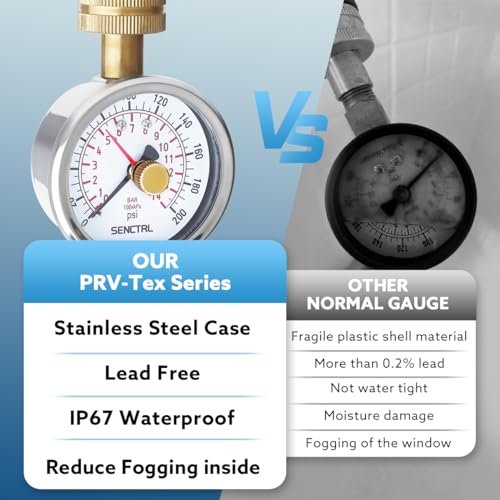
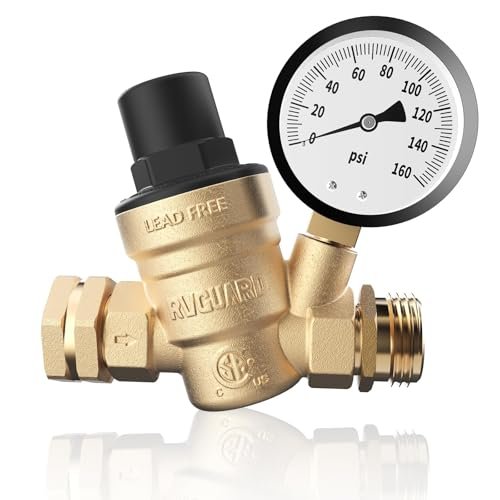
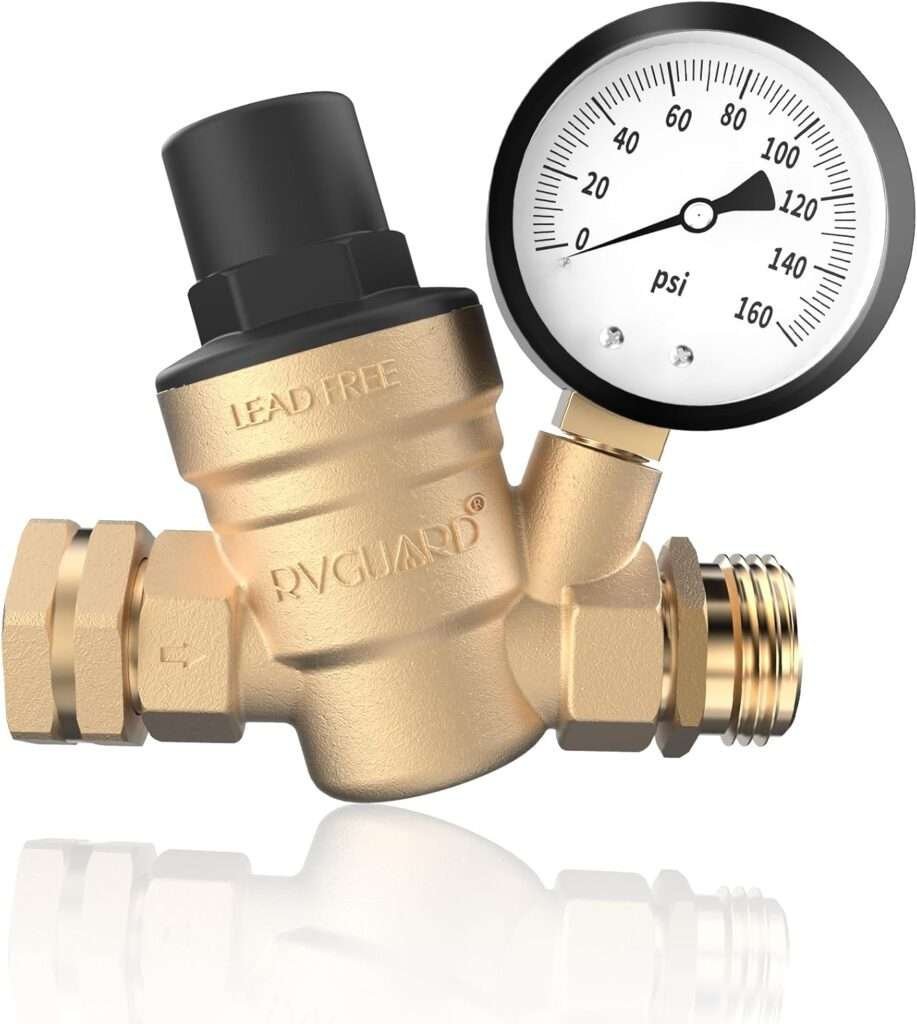
Choose a regulator for potable-water use that meets your motorhome’s pressure and flow needs. An adjustable model with a readable downstream gauge makes setup and diagnosis easier, but a suitable fixed-pressure model can also work.
Fixed versus adjustable regulators
| Type | Suitable use | Main limitation |
|---|---|---|
| Fixed-pressure regulator | A simple setup where its documented outlet pressure matches the RV’s needs | The user cannot change the setpoint |
| Adjustable regulator with gauge | Owners who need to verify and adjust pressure | Requires correct adjustment and gauge checks |
| Higher-flow regulator | Systems where documented flow performance supports greater demand | “High flow” alone is not a standardized performance guarantee |
A larger body or higher price does not prove better flow. Look for performance information at stated inlet pressure, outlet pressure, and flow conditions.
Features worth checking
- Potable-water suitability: The regulator must be intended for drinking-water service.
- Pressure range: Its outlet range must include your required setting.
- Maximum inlet pressure: It must tolerate the supply pressure where you use it.
- Connections: Many U.S. RV hookups use nominal 3/4-inch garden-hose threads. Verify the actual fittings.
- Gauge location: A gauge used to set RV pressure should measure the regulated side.
- Service instructions: Check whether the inlet screen, gauge, seals, or internal parts are serviceable.
- Freeze precautions: Confirm the manufacturer’s draining and storage method.
Garden-hose threads and pipe threads are different. Do not force mismatched fittings together.
What do “lead-free” and NSF markings mean?
“Lead-free” addresses lead content under the applicable standard or legal definition. It does not mean that a regulator filters contaminants or guarantees that the campground water is safe.
NSF/ANSI/CAN 61 concerns health effects of drinking-water system components. NSF/ANSI/CAN 372 addresses lead content. Verify the exact model and certification scope in the certifier’s listing; a logo or broad marketing statement is not enough.
Neither claim, by itself, establishes superior pressure control or flow.
How to Install and Adjust a Motorhome Water Pressure Regulator
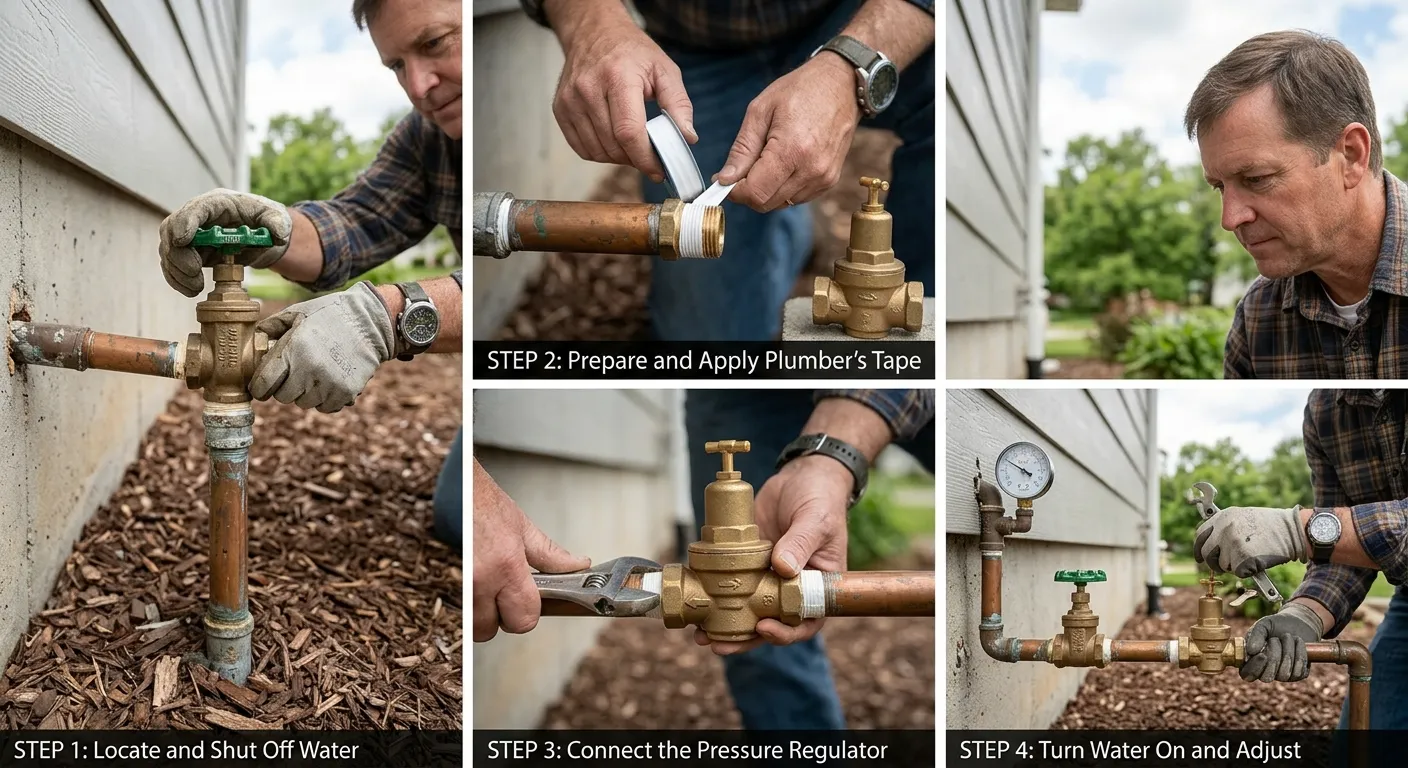
Install the regulator at the campground spigot unless the equipment instructions require a different arrangement. This location limits pressure before water reaches the supply hose.
A typical hookup is:
Campground spigot → regulator → drinking-water hose → filter, if used → motorhome city-water inlet
Filter placement can vary. Follow its instructions and keep the filter housing within its pressure limit.
Before you begin
Have the following ready:
- A suitable regulator and readable downstream gauge.
- A hose rated for drinking water.
- Clean, intact hose washers.
- Your motorhome’s pressure specification.
- A way to shut off the campground water promptly.
Keep hose ends and fittings away from the ground and sewer equipment. Do not use the campground connection if there is an unresolved water-quality warning.
Installation steps
- Turn off the spigot. Open an RV faucet briefly to relieve any pressure already in the hose.
- Inspect the fittings. Check washers, threads, the regulator’s inlet screen, and the hose for damage.
- Flush the spigot briefly. Direct the discharge away from electrical equipment, people, and clean hose ends.
- Attach the regulator. Follow its flow-direction arrow. Avoid using a heavy assembly as a lever on the spigot.
- Connect the hose and other equipment. Follow the approved flow direction for each component.
- Connect to the city-water inlet. Do not confuse it with a tank-fill port or black-tank flush connection.
- Turn off the onboard pump for the initial test. This helps isolate campground-supply performance.
- Open the spigot slowly. Check every joint for leaks.
- Adjust according to the regulator instructions. Some models require water to flow during adjustment. Do not assume that every screw turns the same way.
- Recheck with faucets closed and open. Confirm both safe resting pressure and usable flow.
On many non-relieving regulators, lowering the adjustment does not immediately release pressure trapped downstream. Open a cold-water faucet briefly, close it, and check again.
Signs that the setup is working
The downstream pressure remains within the permitted range, connections stay dry, and fixtures receive usable flow. After use, pressure should return near the setpoint rather than continue climbing.
A brief gauge movement when a faucet closes is different from a steady rise. If pressure will not stabilize, stop and investigate before leaving the hookup unattended.
Avoid overtightening hose fittings
Most garden-hose swivel connections seal against a washer, not the threads. Thread tape usually does not fix a damaged or missing washer.
Use the fitting manufacturer’s tightening instructions. Excess force can damage plastic RV inlets and make the leak worse.
How to Troubleshoot Pressure and Flow Problems
Start with the symptom, then check the simplest and safest causes. Raising the regulator setting should not be the first response to weak water flow.
| Symptom | Possible causes | First useful checks |
|---|---|---|
| Weak flow at every fixture | Weak source, clogged filter, kinked hose, blocked screen, restrictive regulator | Check the supply, hose, screens, and filter condition |
| Weak flow at one fixture | Clogged aerator, showerhead, cartridge, or branch line | Compare other fixtures; clean the affected outlet |
| Normal resting pressure but a large drop during use | Supply limitation or restriction | Check performance one component at a time |
| Pressure rises with all faucets closed | Regulator leakage, thermal expansion, or gauge error | Recheck under controlled, stable conditions |
| Leak at a hose connection | Damaged washer, cross-threading, or loose fitting | Shut off, depressurize, and inspect |
| Gauge stays at zero despite water flow | Gauge fault or a blocked gauge passage | Verify with a suitable known-good gauge |
If pressure drops when the shower runs
First determine whether the issue affects the whole RV or only the shower. A clogged showerhead does not call for a regulator adjustment.
For whole-RV problems, check for:
- A kinked, flattened, or damaged hose.
- A partly closed shutoff valve.
- A dirty inlet screen.
- An overdue or obstructed filter.
- Weak campground supply under demand.
When removing a filter for diagnosis, follow its bypass procedure and protect the drinking-water system from contamination. Do not bypass treatment needed for a known water-quality hazard.
If the campground supply itself is weak, ask park staff to check it. Do not remove pressure protection simply to improve flow.
If pressure slowly climbs after you set it
A regulator that leaks internally may allow downstream pressure to rise toward supply pressure. This is often called pressure creep.
Water heating can also raise pressure when expanding water is trapped by check valves or other components. A gauge fault can further confuse the diagnosis.
To investigate:
- Turn off the water heater’s heat source.
- Let temperatures stabilize.
- Run a cold-water faucet briefly, then close it.
- Watch whether pressure continues to rise.
Do not open hot-water equipment or loosen pressurized fittings. If the cause remains unclear, shut off the city-water supply and have a qualified RV service technician check the regulator, check valves, and expansion behavior.
If a leak appears inside the motorhome
Shut off the campground spigot and onboard pump. If safe, open a faucet to relieve pressure, then dry and inspect the affected area.
Do not assume that reducing pressure repairs a split fitting or loose connection. Keep water away from electrical equipment and have damaged plumbing repaired before reconnecting.

Maintenance, Storage, and Replacement
Inspect the regulator each time you connect, and store it drained where it will not freeze. A pressure gauge confirms little if the regulator is cracked, clogged, or unable to hold its setting.
Routine care includes:
- Cleaning the inlet screen as the instructions permit.
- Checking washers, threads, and seals.
- Protecting openings from dirt during storage.
- Checking the gauge against a suitable known-good gauge when readings seem doubtful.
- Following the manufacturer’s cleaning and service instructions.
Do not apply household cleaners or lubricants to potable-water parts unless the manufacturer permits them.
When should you replace it?
Replace or service the regulator when it has freeze damage, a cracked body, persistent leaks, unstable control, or confirmed pressure creep. A faulty gauge may be replaceable separately if the design allows it.
Do not rely on a universal replacement interval. Condition, water quality, storage, and serviceability matter more than age alone.
Freezing and pressure relief require separate protection
A regulator does not prevent water from freezing. Drain it as directed and store it in a frost-free place; follow your motorhome’s full winterization procedure for the rest of the system.
A regulator also does not replace a water heater’s temperature-and-pressure relief valve. Never cap, plug, or disable that valve.

Frequently Asked Questions
Do I need the regulator when using the onboard fresh-water tank?
An external hookup regulator normally controls water coming from the campground, not water supplied by the onboard pump. The pump has its own pressure-control arrangement.
If pressure is excessive or unstable while using only the tank, check the pump system and the motorhome’s service instructions.
Does a regulator protect the RV while filling the fresh-water tank?
It depends on the fill design. Some motorhomes fill the tank through a selector valve connected to the pressurized city-water inlet. Others use a separate gravity-fill opening.
Follow the fill instructions for your model. Never seal a hose into a gravity-fill opening or block the tank vent.
Can I leave the city water connected overnight?
A regulator limits pressure, but it cannot stop every leak or close the supply after a hose fails. Leaving the system pressurized always leaves some risk.
Shut off the spigot when leaving the motorhome unattended for an extended period. A water alarm or compatible automatic shutoff can add protection, but neither replaces sound plumbing.
Does the regulator prevent backflow?
Not necessarily. Pressure regulation and backflow prevention are different functions.
Keep any campground-required backflow device in place. Do not remove it to gain flow, and do not assume that an RV inlet check valve meets every local requirement.
Can I use a residential pressure regulator?
Only if it is suitable for potable water and its pressure range, inlet rating, flow capacity, installation orientation, and fittings suit the application.
Residential units may need adapters and mechanical support. A heavy assembly hanging from a campground spigot can strain the connection.
Evidence, Sources, and Research Limits
This is a general U.S. hookup guide, not a model-specific installation procedure. Live browsing and hands-on testing were not available for this article. No current competitor rankings, product revisions, prices, or certification listings were verified.
Use these primary-source resources to confirm the details that govern your setup:
- Winnebago owner resources: Locate the manual for the exact motorhome model and year.
- Jayco owner resources: Check model-specific water-system instructions where applicable.
- EPA guidance on lead-free drinking-water plumbing: Review the scope of federal lead-free requirements.
- NSF drinking-water system component listings: Verify a listed product’s exact identity and certification scope.
The motorhome manual establishes vehicle-specific limits. The regulator and filter manuals establish their installation and operating requirements. Certification records support only the claims within their stated scope.
Next-question gap map
These questions are inferred next needs from the hookup task, not verified search-demand findings. Competitor coverage is marked “not checked” because no competing pages were inspected.
| Question | Reader stage and basis | Competitor coverage | Reader benefit and evidence needed | Priority and placement |
|---|---|---|---|---|
| Why is shower flow low despite normal resting pressure? | During use; inferred from the pressure-versus-flow distinction | Not checked | Avoids unsafe pressure increases; requires flowing-pressure checks and component inspection | High; troubleshooting |
| Why does pressure rise after adjustment? | After setup; inferred from regulator and heated-water behavior | Not checked | Helps distinguish regulator leakage from expansion; requires controlled measurements and model guidance | High; troubleshooting |
| Does an onboard regulator protect the supply hose? | Before hookup; inferred from component location | Not checked | Clarifies which parts remain upstream; requires the RV plumbing diagram | High; regulator function |
| Does tank filling need the same protection? | During filling; inferred from different fill designs | Not checked | Prevents misuse of gravity-fill openings; requires model-specific fill instructions | High; FAQs |
No competitor gap or product-performance advantage is claimed without inspection or testing.
Conclusion
Choose a potable-water regulator that matches your motorhome’s documented pressure limits and flow needs. Install it at the spigot when the equipment instructions allow, then check both resting pressure and pressure during use.
Before your next hookup, find your RV’s city-water pressure specification and inspect the regulator, gauge, hose, and washers. If pressure keeps rising, leaks appear, or readings remain uncertain, shut off the supply and resolve the fault before leaving the system pressurized.