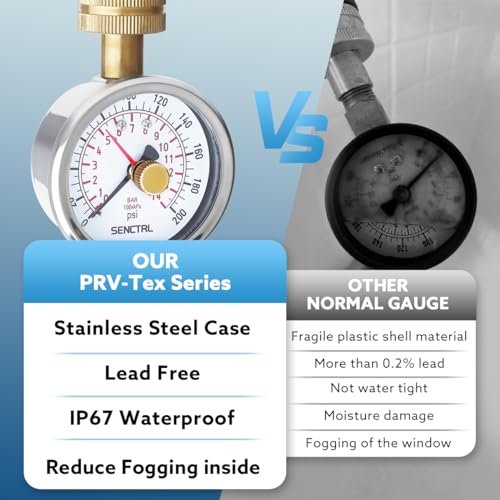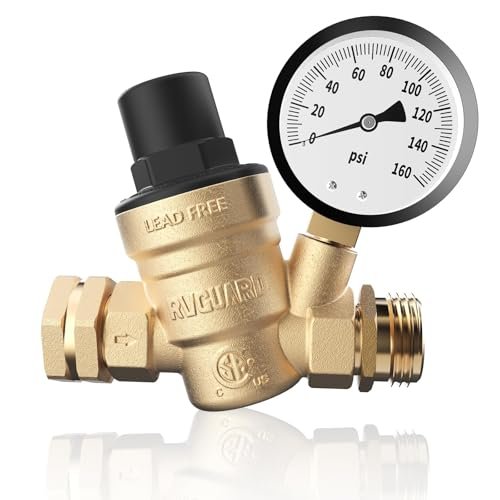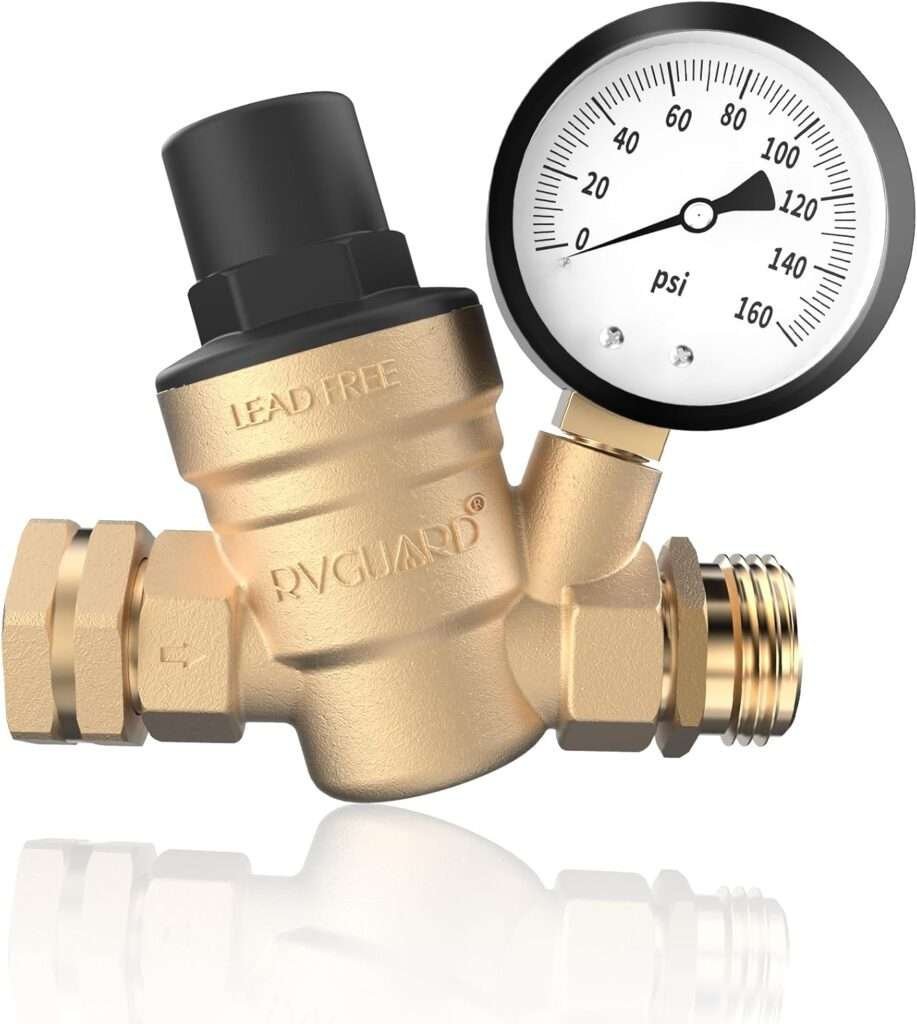

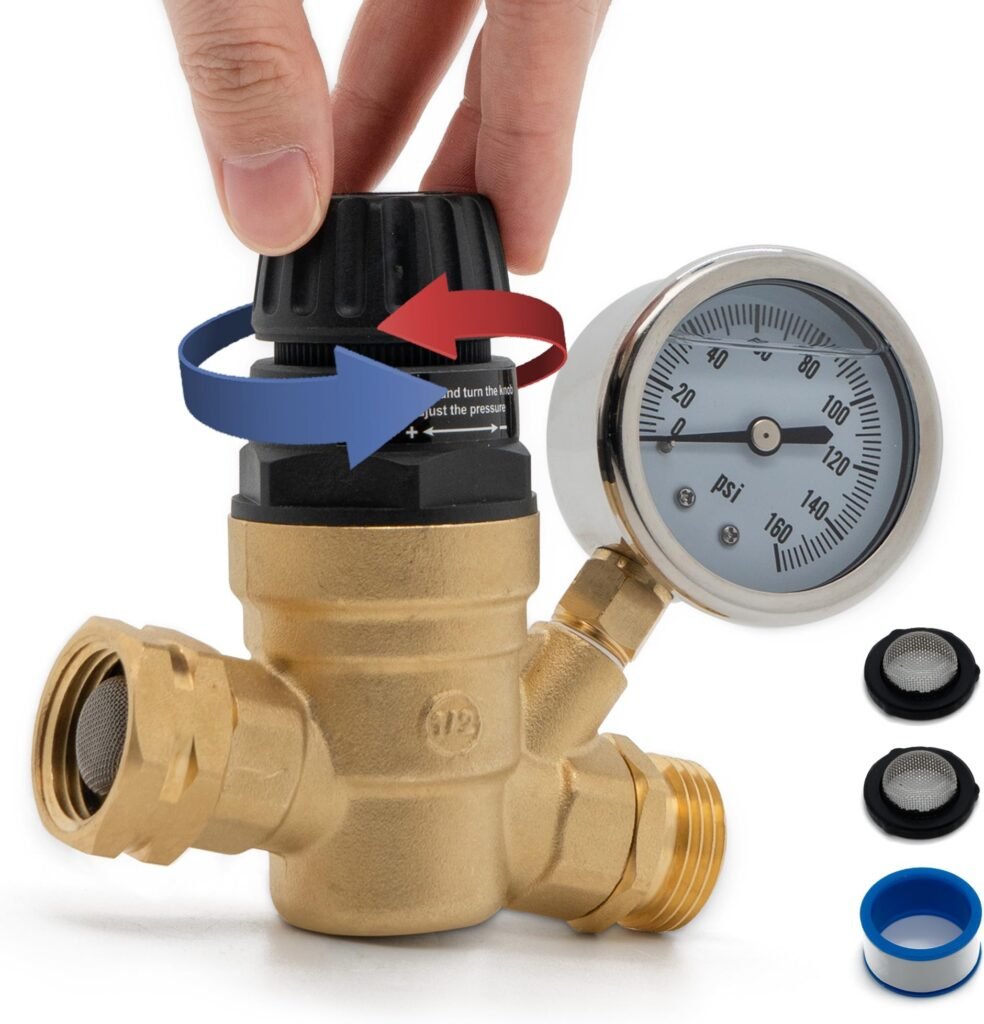
I use a potable-water Pressure Regulator For Camper hookups to help protect my drinking-water hose and plumbing from excessive campground pressure. When equipment instructions allow, I install it at the campsite spigot.
While 40–50 psi is a common starting range, I follow my camper’s manual and every connected component’s pressure limits. If those limits are unknown, I confirm them before connecting.
This guide covers freshwater hookups for travel trailers, fifth wheels, truck campers, and motorhomes. A propane pressure regulator is a different device and must never be used in a water system.

What Does a Camper Water Pressure Regulator Do?
A water pressure regulator reduces higher supply pressure to a controlled downstream pressure. It helps protect the hose, fittings, valves, and other parts connected to your camper’s city-water inlet.
A pressure-reducing valve typically uses a spring and diaphragm to adjust an internal opening. As downstream pressure changes, the valve responds to help maintain its setting. Performance still depends on the regulator’s design, incoming pressure, and water demand.
Three terms matter when choosing and using one:
- Pressure, measured in psi: The force within the water system.
- Flow, measured in gallons per minute (GPM): The amount of water delivered over time.
- Static pressure: Pressure when no fixtures are drawing water.
Pressure and flow are not the same. A shower can have poor flow even when a gauge shows adequate static pressure. A clogged filter, narrow hose, blocked screen, or restrictive regulator may be the cause.
A regulator also cannot raise low campground pressure. It works like a gate, not a pump.
“For help choosing a regulator for your camper, see my Best RV Water Pressure Regulator guide, where I compare adjustable models, gauge features, and ease of use.”

What Water Pressure Should You Use in a Camper?
Use the operating pressure allowed by your RV manufacturer, and stay within the ratings of every connected component. Do not treat a generic internet recommendation as approval for your specific camper.
The hose, filter housing, adapters, and other parts may have limits below the RV’s stated limit. A burst-pressure rating is not the same as a continuous working-pressure rating.
Use this table to decide what to do:
| Situation | Recommended action | Reason |
|---|---|---|
| Your manual states a maximum inlet pressure | Set the regulator below that limit, allowing for gauge error and pressure variation | Operating at the exact limit leaves little margin |
| Your manual gives a recommended operating range | Use that range and check pressure with fixtures closed and running | Both static and flowing conditions matter |
| You cannot find a pressure specification | Confirm it with the RV manufacturer before connecting | Plumbing materials alone do not establish the whole system’s rating |
| The shower feels weak at a suitable setting | Check flow restrictions before raising pressure | More pressure may not fix the cause |
| Campground pressure is below your desired setting | Expect lower delivered pressure | A regulator cannot boost the supply |
Is 40–50 psi always safe?
No. It is a common practical range, not a guarantee for every camper or accessory.
For example, if an owner’s manual allows up to 50 psi, a setting near 45 psi leaves more room than setting the gauge exactly at 50 psi. This is an illustrative setup choice—not a substitute for the manufacturer’s instructions.
Avoid choosing a setting based only on a claim that the camper has PEX tubing. The complete system includes connectors, fixtures, valves, and appliances, each with its own limits.
How to Choose a Pressure Regulator for Your Camper
Choose a regulator based on its pressure range, potable-water suitability, flow capacity, and connection type. A higher price or larger body does not, by itself, prove better protection.
Fixed versus adjustable regulators
The main trade-off is simplicity versus control.
| Type | Best fit | Main limitation |
|---|---|---|
| Fixed-pressure regulator | Owners who want a preset outlet pressure that matches their RV’s requirements | The setting cannot be changed; delivered pressure can still vary with conditions |
| Adjustable regulator with an outlet gauge | Owners who need to set and monitor pressure | Requires correct setup and periodic checks |
| Flow restrictor | Applications that only need reduced flow | Not a substitute for a true pressure-reducing regulator |
A small opening can reduce flow while a faucet runs without reliably limiting pressure once the faucet closes. Confirm that the device is a pressure regulator, not merely a flow-control fitting.
Check potable-water materials and certification
Use a regulator intended for drinking-water service. Do not assume that any brass plumbing fitting or garden accessory is suitable.
The U.S. Environmental Protection Agency explains that the federal “lead free” definition generally allows a weighted average lead content of no more than 0.25% across the wetted surfaces of covered pipes, fittings, and fixtures. “Lead free” does not mean that every part contains zero lead.
Certification claims also have different scopes:
- NSF/ANSI/CAN 372 addresses lead content.
- NSF/ANSI/CAN 61 addresses drinking-water health effects within the listing’s scope.
Neither standard alone establishes a regulator’s flow capacity, pressure accuracy, or service life. Where certification is claimed, check the exact model in the relevant certification directory, such as NSF’s drinking-water component listings.
Check the practical specifications
Before buying, confirm:
- The inlet pressure rating covers the expected supply pressure.
- The outlet range suits your camper.
- The connections fit your hose and hookup.
- The gauge measures regulated outlet pressure.
- The manufacturer provides installation and adjustment instructions.
- Published flow information includes test conditions, where available.
Many U.S. RV drinking-water hoses use nominal 3/4-inch garden-hose-thread connections. Those threads are not interchangeable with 3/4-inch tapered pipe threads.
A “high-flow” label is less useful than a flow rating tied to inlet pressure, outlet pressure, and pressure loss.
How to Install and Set a Camper Water Pressure Regulator
Install the regulator at the campground spigot, before the drinking-water hose, unless the device manufacturer specifies otherwise. This placement protects the hose as well as the camper.
You will need a potable-water hose, sound hose washers, the regulator, and your RV’s pressure specification. Use an outlet gauge to verify pressure if the regulator does not include one.
1. Confirm the correct water connection
Identify the camper’s city-water inlet and any required water-panel setting. Do not connect the drinking-water hose to a black-tank flush port.
Turn off the onboard water pump for the initial hookup check. Follow the RV manual if your water system has special valve positions or connection procedures.
2. Inspect and briefly flush the spigot
Check for damage and contamination. If campground rules allow, briefly run the spigot to clear loose debris before attaching the regulator.
Keep hose ends off the ground. Flushing does not make an unsafe water source safe; use a supply designated for drinking water.
3. Connect the regulator in the correct direction
Match the regulator’s flow arrow to the direction of water travel.
A typical arrangement is:
Campground spigot → regulator → drinking-water hose → approved filter arrangement → camper city-water inlet
Filter location can vary. Keep the filter housing within its pressure rating and follow its instructions. A filter’s pressure drop is not a substitute for pressure regulation.
4. Check the seals
Inspect hose washers for cracks, flattening, or missing pieces. Tighten connections as directed without placing excessive strain on the spigot or RV inlet.
Standard garden-hose connections seal against a washer, not the threads. Thread tape usually will not fix a damaged washer. Tapered pipe-thread joints are different and may require an approved sealant.
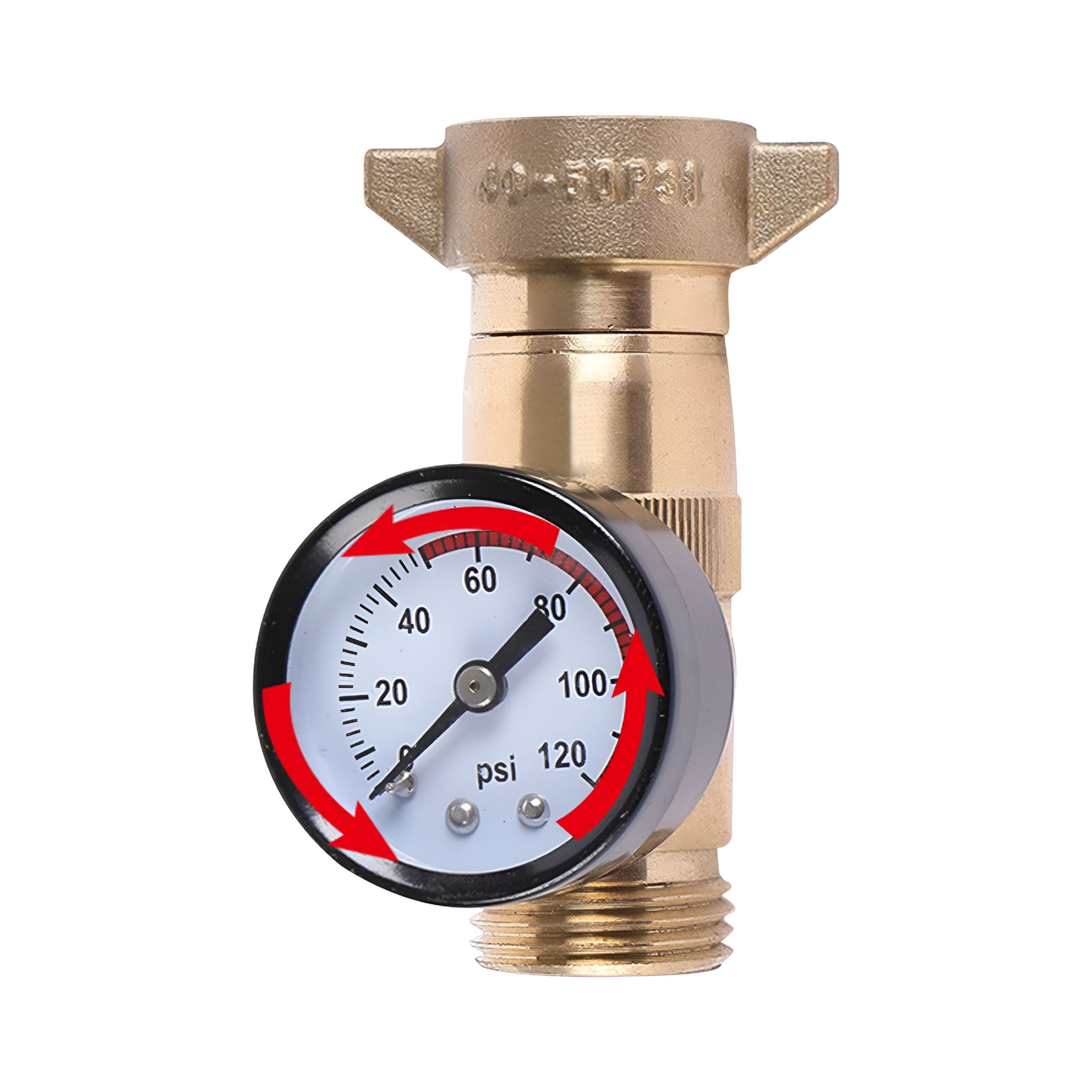
5. Open the supply slowly and set the pressure
Follow the regulator’s adjustment procedure. Some models specify adjustment with water flowing; others use a static-pressure procedure.
Do not assume that turning the screw clockwise increases pressure. Confirm the direction for your model.
If reducing the setting does not immediately lower the gauge reading, pressure may be trapped downstream. Open a cold-water faucet briefly to release it, then check again.
6. Test with fixtures closed and running
Close the fixtures and check static pressure. Then run a cold-water faucet and observe the pressure and flow.
After that, test two fixtures together. A noticeable drop may point to limited campground supply or a restriction in the hose, filter, screen, or regulator.
7. Check for leaks and recheck pressure
Inspect each accessible connection. Recheck after several minutes, especially when all faucets are closed.
A successful setup has:
- No visible leaks.
- Pressure within the RV and accessory limits.
- Stable pressure after fixtures close.
- Adequate flow for normal use.
If pressure keeps climbing, exceeds the permitted limit, or cannot be controlled, shut off the spigot and disconnect until the cause is resolved.
How to Troubleshoot Low Flow or Rising Pressure
Check the symptom before changing the setting. Raising pressure can hide a restriction without fixing it.
| Symptom | Possible causes | First useful checks |
|---|---|---|
| All fixtures have low flow | Weak supply, kinked hose, clogged filter or inlet screen, restrictive regulator | Check hose routing, screens, and filter condition |
| Only one fixture has low flow | Blocked aerator, showerhead, or fixture cartridge | Inspect and clean that fixture |
| Gauge pressure falls sharply when water runs | Limited supply or excessive restriction | Compare static and flowing readings; isolate restrictions safely |
| Gauge shows zero while water still flows | Failed, blocked, or incorrectly positioned gauge | Verify gauge location and compare with a suitable known-good gauge |
| Pressure rises after all faucets close | Regulator leakage, trapped pressure, or thermal expansion | Confirm the gauge reading and follow RV and water-heater guidance |
| Hose fitting leaks | Damaged washer, cross-threading, or strain | Shut off water, release pressure, and inspect the seal |
Why can pressure rise after the regulator?
A regulator controls pressure entering the downstream system. It does not necessarily relieve pressure that develops within that system.
Water expands as it heats. If check valves or other devices create a closed system, water-heater operation can increase downstream pressure. Some regulators allow reverse flow under certain conditions; others do not.
A rising gauge reading does not prove a single cause. It may reflect regulator leakage, thermal expansion, or a gauge problem. Do not remove check valves, alter relief devices, or change water-heater safety parts as a shortcut.
If the pressure continues to rise or a water-heater relief valve discharges, follow the appliance instructions and have a qualified RV technician inspect the system. Never plug or cap a relief valve.
How to narrow down a low-flow problem
Start with a kinked hose, closed valve, dirty screen, and clogged filter. These checks are useful and usually require little disassembly.
Only bypass a component if its instructions and the water source permit it. Do not send unregulated campground water into the camper merely to test whether the regulator is restrictive.
Common Mistakes and Maintenance Needs
Keep the regulator clean, protected from freezing, and within its ratings. Replace or service it when pressure control becomes unreliable.
Avoid these common mistakes:
- Placing the regulator only at the RV inlet. That leaves the upstream hose exposed to full supply pressure.
- Setting pressure exactly at the system limit. Gauge error and changing conditions can push the actual pressure higher.
- Treating a gauge as permanent proof of accuracy. Gauges can stick, drift, or suffer freeze damage.
- Using a non-potable hose. A regulator does not make the hose suitable for drinking water.
- Using the regulator as a backflow preventer. Pressure regulation and backflow protection are different functions.
- Leaving water trapped during freezing weather. Ice can damage the body, gauge, and internal parts.
Inspect the regulator when you connect and before long-term storage. Clean inlet screens as the manufacturer directs, and drain the unit according to its instructions.
There is no universal replacement interval. Replace or professionally service a unit that leaks, has freeze damage, will not hold a stable setting, or cannot be verified with a suitable gauge.
A regulator also does not filter contaminants, disinfect water, or guarantee protection from every brief pressure surge.

Frequently Asked Questions
Do I need a regulator when using the freshwater tank and onboard pump?
An external hookup regulator generally does not control water supplied by the onboard pump. The pump has its own pressure-control system.
Use a regulator when connecting an outside pressurized supply where the RV instructions require it. Do not change pump settings without following the pump and camper manuals.
Does my camper already have a built-in regulator?
It might, but a city-water inlet does not automatically include one. An inlet check valve prevents reverse flow; it is not necessarily a pressure regulator.
Check the exact RV model’s manual or plumbing documentation. Even with built-in regulation, the hose before the camper may remain exposed to campground pressure.
Can I leave campground water connected overnight?
Follow the campground rules and your RV manufacturer’s guidance. A regulator does not detect leaks or shut off water when a pipe fails.
Turn off the campground supply when leaving the camper unattended. For added protection, consider a compatible leak-detection system with an automatic shutoff.
Can the same regulator serve a black-tank flush connection?
Do not move drinking-water equipment onto a waste-system connection. Keep black-tank flush equipment separate and clearly marked.
Follow the RV manufacturer’s flushing procedure, including its backflow-protection requirements.
Is a propane regulator interchangeable with a water regulator?
No. Propane regulators control fuel gas and use different designs, pressure ranges, connections, and safety requirements.
If the problem involves propane odor, stop using the system and follow the RV’s emergency instructions. Have gas-system faults handled by a qualified professional.
Evidence, Sources, and Research Limits
This guide is a practical synthesis, not a hands-on product test. Live browsing was unavailable during preparation, so current competitor pages, product revisions, prices, and individual model certifications were not verified. No current search rankings, field measurements, or product-superiority claims are asserted.
The linked EPA guidance supports the lead-content explanation. NSF’s directory provides a way to verify specific certification claims. Neither source establishes the correct pressure setting for an individual RV.
For model-specific limits, use your camper’s manual and the regulator’s instructions. Manufacturers may provide documents through owner portals; for example, Winnebago publishes operator manuals. A manual for one model should not be applied to another without confirmation.
Next-question gap map
These are inferred next needs, based on the hookup and troubleshooting process—not verified search-demand findings. Competitor coverage is not checked because no competing pages were inspected.
| Question | Reader stage | Basis | Reader benefit and evidence needed | Priority and placement |
|---|---|---|---|---|
| Does an inlet-mounted regulator protect the hose? | Setup | Inferred from component placement | Explains which parts remain exposed; verify installation instructions | High; installation section |
| Why does pressure rise with faucets closed? | Troubleshooting | Inferred from pressure-control behavior | Separates possible regulator faults from thermal expansion; check exact valve and heater documentation | High; troubleshooting section |
| Why is flow weak despite a suitable gauge reading? | Use | Inferred from pressure-versus-flow differences | Prevents unnecessary pressure increases; use static and flowing checks | High; definitions and troubleshooting |
| Does a built-in check valve regulate pressure? | Purchase and setup | Inferred from distinct valve functions | Prevents false assumptions; verify the RV’s inlet assembly | High; FAQs |
Conclusion
For most campground hookups, the practical choice is a potable-water regulator that matches your camper’s pressure requirements and lets you verify outlet pressure. Install it at the spigot, check both static and flowing pressure, and address restrictions before raising the setting.
Your next step: Find your camper’s maximum city-water pressure in its owner’s manual. Then check that the regulator, hose, and filter all suit that limit before connecting.