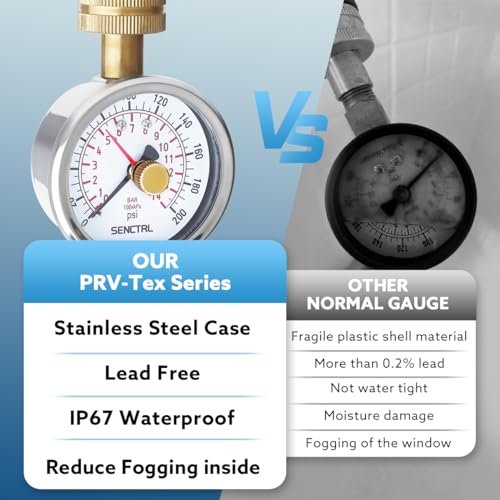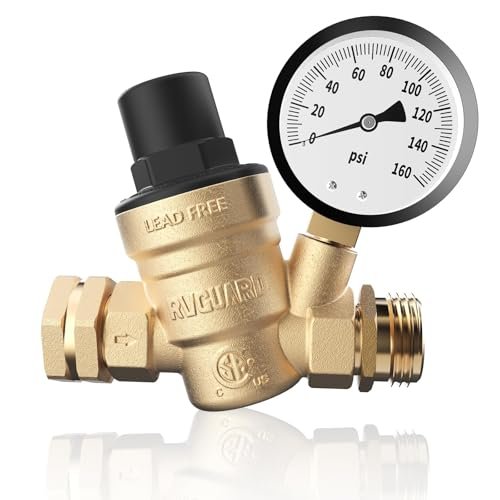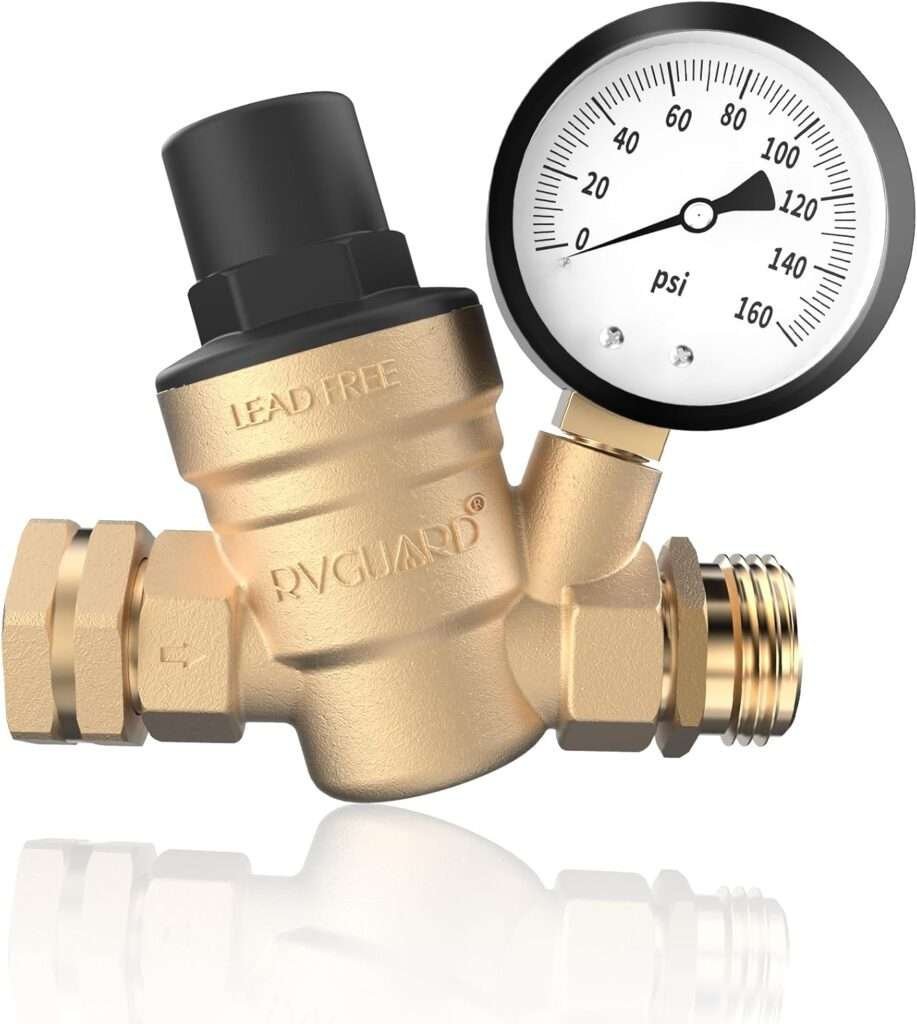


I recommend using a potable-water RV Pressure Regulator at campground city-water hookups to help protect your drinking-water hose and RV plumbing. When equipment instructions allow, I position it at the campsite spigot.
While 40–50 PSI is common for many setups, I check the RV owner’s manual and follow the lowest applicable pressure limit among the RV, hose, filter housing, and fittings—not a universal setting.
This guide covers freshwater regulators only. Water and propane regulators are not interchangeable.
“Don’t let excessive campground water pressure put your plumbing at risk. Explore my Best RV Water Pressure Regulator guide to compare adjustable models and find the right fit for your next hookup.“

What Does an RV Water Pressure Regulator Do?
An RV water pressure regulator lowers a higher supply pressure to a controlled downstream pressure. It acts as a gatekeeper between the campground water supply and your RV’s freshwater system.
Inside a typical regulator, a valve works with a spring and diaphragm or piston. As downstream pressure changes, the valve adjusts how much water can pass. The result is reduced pressure on the outlet side, within the device’s operating limits.
A regulator helps protect hoses, fittings, faucets, toilet valves, and other connected parts from excessive supply pressure. It does not make damaged plumbing sound, clean unsafe water, or guarantee protection against every pressure surge.
Pressure and flow are not the same
Pressure is force; flow is the amount of water moving. Pressure is measured in PSI. Flow is often measured in gallons per minute, or GPM.
You can have a normal pressure reading and still get a weak shower. A clogged filter, narrow hose, partly closed valve, or restrictive regulator can reduce flow.
A regulator also cannot boost low campground pressure. If the supply is weak, turning an adjustment screw higher will not create more pressure than the source provides.
What PSI Should an RV Pressure Regulator Be Set To?
Use the pressure specified by your RV manufacturer, while staying within every connected component’s rating. Do not assume that a setting used by another RV owner is right for your rig.
Check these sources before making an adjustment:
- Your RV owner’s manual or manufacturer’s support guidance.
- The regulator’s instructions and adjustment range.
- The hose’s working-pressure rating.
- The filter housing’s maximum working pressure.
- Any limits for other connected equipment.
A hose’s burst-pressure rating is not its normal working-pressure rating. Likewise, a water-heater relief valve’s rating is not a target for the freshwater system.
Use this table to guide the decision:
| Situation | What to do |
|---|---|
| The RV manual gives a pressure limit | Stay within that limit and any lower component limit |
| The manual gives a recommended range | Set the regulator within that range |
| The RV’s limit is unknown | Ask the manufacturer; do not assume 60 PSI or more is acceptable |
| A connected filter has a lower rating | Keep pressure within the filter’s rating or use a suitable filter |
| Supply pressure is below the desired setting | Check the supply and restrictions; a regulator cannot boost pressure |
Why “set it to 50 PSI” is incomplete advice
A regulator’s reading may change between no-flow and flowing conditions. Some pressure loss while water runs is normal, and the amount depends on the regulator and the system.
For example, a hypothetical setup might read 45 PSI with all faucets closed and 37 PSI with the shower running. That difference alone does not prove the regulator is faulty. You also need to know the inlet pressure, flow demand, and pressure loss through the hose and filter.
The useful goal is adequate flow at a pressure your system permits, not the highest number on the gauge.

How to Choose an RV Pressure Regulator
Choose a regulator based on its pressure range, potable-water suitability, flow capacity, and ease of checking. Price or a large gauge alone does not establish performance.
Fixed versus adjustable regulators
A fixed regulator has a preset outlet pressure. An adjustable regulator lets you change the setting within its stated range.
| Type | Main benefit | Main limitation | Best fit |
|---|---|---|---|
| Fixed-pressure regulator | Simple setup with no routine adjustment | Its preset pressure may not suit every RV | Owners whose system limits match the documented preset |
| Adjustable regulator with gauge | Allows setting changes and pressure checks | Requires correct setup and a usable gauge | Owners who want to monitor and adjust pressure |
| Adjustable regulator without gauge | Offers pressure adjustment | Needs a separate downstream gauge for accurate setup | Systems with a suitable gauge already installed |
“High flow” is useful only when the manufacturer provides meaningful specifications. Compare rated flow, inlet pressure, outlet pressure, and test conditions when available. A larger body or higher price does not, by itself, prove better flow.
What to check before buying
Look for these details:
- Potable-water use: The regulator should be intended for drinking-water service.
- Pressure ratings: Its maximum inlet pressure and outlet range must suit the application.
- Connections: Many U.S. RV hose setups use nominal 3/4-inch garden-hose connections. Confirm the actual fittings.
- Gauge location: To check regulated pressure, the gauge must read downstream of the regulating valve.
- Service instructions: Check whether screens, seals, or gauges can be cleaned or replaced.
- Temperature limits: Follow the stated limits, especially in freezing weather.
Do not confuse garden-hose threads with pipe threads. Similar-looking fittings may have different thread forms and sealing methods.
What “lead-free” does—and does not—mean
For covered drinking-water plumbing products, the U.S. Environmental Protection Agency explains that “lead-free” generally means a weighted average lead content of no more than 0.25% across wetted surfaces. That does not mean zero lead, and it does not prove that a device removes contaminants.
Certification claims also have specific scopes. NSF/ANSI/CAN 372 addresses lead content, while NSF/ANSI/CAN 61 addresses health effects related to materials in drinking-water components. Verify the exact model and listed scope, rather than relying on a logo in a product image.
How to Install and Set an RV Pressure Regulator
Place the regulator at the campsite spigot, ahead of the drinking-water hose, unless the equipment instructions require another arrangement. This helps protect the hose as well as the RV.
A common connection order is:
Campground spigot → regulator → potable-water hose → filter, if used → RV city-water inlet
Filter placement can vary. Follow the filter’s instructions and pressure rating. A filter placed ahead of the regulator receives the full campground supply pressure.
Before you start
Have these items ready:
- A regulator suitable for potable water.
- A drinking-water hose in sound condition.
- A downstream pressure gauge, built in or separate.
- Sound hose washers.
- Your RV’s pressure guidance.
- A support or short flexible connection if needed to avoid straining the spigot.
Keep freshwater fittings away from sewer hoses and waste-handling gear. Use only a supply identified as potable water.
Installation steps
Turn off the spigot. Confirm that you are connecting to the RV’s city-water inlet, not a tank-flush port.
Inspect the fittings. Check for cracked washers, damaged threads, dirt, and a blocked inlet screen.
Briefly flush the spigot. Direct the water away from people and your clean fittings, then shut it off.
Attach the regulator. Follow its flow-direction arrow. Avoid hanging a heavy, unsupported assembly from a small spigot.
Connect the hose and other equipment. Keep connections clean. Hand-tighten washer-sealed hose fittings unless the instructions say otherwise.
Open the supply slowly. Check each joint for leaks before leaving the connection.
Purge trapped air. Open a cold-water faucet until the flow is steady, then close it.
Set the pressure as directed. Use the regulator’s adjustment procedure and your RV’s permitted pressure. Some models specify adjustment while water flows.
Check the pressure again. Observe the gauge with faucets closed and with a faucet running. Recheck after several minutes.
Do not assume that turning an adjustment screw clockwise always follows the correct procedure for your model. Read the instructions before changing the setting.
Signs that the setup is working
The connections should remain dry, water should flow without persistent sputtering, and the downstream pressure should stay within the permitted range.
A modest pressure change when a faucet opens can be normal. A repeated rise toward supply pressure with all fixtures closed needs investigation.
If the installation leaks
Shut off the supply and release pressure before taking fittings apart. Check the washer, alignment, and sealing surface first.
Most garden-hose connections seal with a washer, not thread tape. Tape will not fix a missing washer or a cracked fitting. Use sealant on pipe-thread connections only where the manufacturer calls for it.

Troubleshooting Low Pressure, High Pressure, and Gauge Problems
Check the supply and simple restrictions before replacing the regulator. The gauge reading is one clue, not a complete diagnosis.
| Symptom | Possible causes | First useful checks |
|---|---|---|
| Weak flow at every fixture | Low supply pressure, kinked hose, clogged filter, blocked screen, restrictive regulator | Check the hose, valves, screen, and filter |
| Weak flow at one fixture | Clogged aerator, showerhead, or fixture valve | Inspect that fixture first |
| Pressure drops sharply when water runs | Inadequate supply or excessive restriction | Compare pressure before and after likely restrictions |
| Outlet pressure is too high | Incorrect setting, faulty gauge, debris, failed regulator, thermal expansion | Shut off supply, verify the gauge, then follow service instructions |
| Pressure rises slowly with fixtures closed | Regulator leakage, thermal expansion, or gauge error | Note whether heating is involved and test systematically |
| Gauge remains at zero | No supply, blockage, failed gauge, or closed regulator | Confirm supply and gauge operation |
| Hose connection leaks | Worn washer, misalignment, damaged fitting | Depressurize and inspect the joint |
Use gauge location to find pressure loss
A gauge at the regulator cannot show every pressure loss farther downstream. If that gauge looks normal but faucet flow is weak, the hose, filter, inlet screen, or fixture may be the restriction.
Where practical, compare readings before and after a suspect part under similar flow conditions. Do not compare a static reading at one point with a flowing reading at another and treat the difference as a clean test.
What is pressure creep?
Pressure creep is a gradual increase in downstream pressure while fixtures are closed. Debris or damage may prevent the regulator’s valve seat from sealing fully.
Thermal expansion is another possible cause. Water expands as a water heater heats it, and check valves can limit where that expansion can go. A regulator does not necessarily provide a path for expanded water to escape.
Never plug a water-heater temperature-and-pressure relief valve or alter it to stop dripping. If pressure rises during heating, the relief valve discharges, or the cause is unclear, have a qualified RV technician assess the system.
When to stop troubleshooting
Disconnect from city water if pressure cannot be controlled or a component leaks. Stop using the suspect equipment until the fault is resolved.
Seek qualified help for hidden leaks, water damage, cracked plumbing, repeated unexplained pressure rise, or water-heater safety-valve concerns.
Maintenance, Freezing, and Replacement
Inspect the regulator at each hookup and protect it from freezing. Damage may not be visible until the device is pressurized.
Check the body, gauge, threads, washers, and inlet screen. Clean removable screens only as directed. Do not open a sealed regulator or adjust internal parts without service instructions.
For storage, shut off the source, release pressure, disconnect the device, and drain it according to the manufacturer’s directions. Trapped water can freeze and damage the body, gauge, or internal parts.
Replace or professionally service the regulator if it:
- Has a cracked body or freeze damage.
- Cannot hold the permitted outlet pressure.
- Leaks from the housing.
- Has a gauge that cannot be trusted.
- Fails the manufacturer’s checks after cleaning.
Do not assume a fixed replacement interval applies to all models. Condition, water quality, use, and the maker’s guidance matter more than an unsupported calendar rule.
Frequently Asked Questions
Do I need a regulator when filling the freshwater tank?
It depends on the fill system. An open gravity-fill port differs from a pressurized fill connection routed through valves and plumbing.
Follow your RV’s fill instructions. Do not seal a hose into a gravity-fill opening or obstruct the tank vent. A freshwater tank is not a pressure vessel.
Does an RV pressure regulator control the onboard water pump?
A regulator at the campsite spigot normally controls incoming city water, not the onboard pump. Pump pressure is governed by the pump and the RV’s plumbing design.
If pressure problems occur only while using tank water, check the pump system rather than assuming the external regulator is responsible.
Is an air bubble in a liquid-filled gauge a defect?
Not necessarily. A visible bubble can be part of a liquid-filled gauge’s design.
The useful checks are whether the gauge leaks, returns appropriately when pressure is released, and reads accurately. Follow any venting instructions for that exact gauge.
Why does the freshwater tank fill while connected to city water?
Possible causes include an incorrectly positioned fill valve or leakage through a check valve. The exact diagnosis depends on the RV’s plumbing layout.
Check the owner’s manual and valve positions first. A pressure regulator does not repair a faulty valve or check valve.
Can I leave campground water on while away?
Turning off the spigot when you leave reduces the amount of water available to feed a leak. A regulator limits pressure; it does not normally detect a broken hose or close when a leak starts.
Leak sensors and automatic shutoff systems can add protection, but their coverage and operating limits vary.
Conclusion
An RV pressure regulator helps control one clear risk: excessive pressure from an external water supply. Choose a potable-water model with suitable ratings, install it ahead of the hose when permitted, and set it to your RV’s documented limits.
Before your next hookup, find the pressure guidance for your rig and check the hose, washers, filter, and gauge. If flow is weak, diagnose the restriction rather than simply raising the pressure.
Sources and Research Scope
This guide is a general U.S. freshwater-plumbing explanation, not a model-specific installation manual or a hands-on product test. Live browsing was unavailable, so current competitor pages, product revisions, certifications, and individual RV manuals were not inspected. No current search positions or product-performance rankings are claimed.
Use these primary-source resources to verify requirements and exact-model claims:
- U.S. EPA: Use of Lead-Free Pipes, Fittings, Fixtures, Solder, and Flux for Drinking Water — federal lead-free requirements and scope.
- NSF Certified Drinking Water System Components — searchable listings for model-specific certification checks.
- Your RV manufacturer’s owner’s manual — permitted pressure, fill-valve operation, winterization, and plumbing configuration.
- Your regulator, hose, and filter manuals — pressure ratings, connection order, adjustment, cleaning, and storage instructions.
Next-question gap map
These are inferred next needs, based on the setup and troubleshooting task—not verified search-demand findings. Competitor coverage remains not checked because live research was unavailable.
| Question | Reader stage and basis | Reader benefit | Evidence needed | Priority and placement |
|---|---|---|---|---|
| Why is flow weak despite a normal gauge reading? | During setup; pressure and flow can differ | Avoids unsafe pressure increases | Regulator flow data and pressure checks across components | High; troubleshooting |
| Why does pressure rise after the water heats? | After setup; closed-system pressure can change | Helps distinguish regulator faults from thermal expansion | RV plumbing layout and water-heater instructions | High; troubleshooting |
| What changes when using tank fill or the pump? | Before switching water modes; systems differ | Prevents applying city-water advice to the wrong circuit | Exact RV and pump manuals | High; FAQs |