
When I assess a campground water hookup, pressure control is one of my first considerations. Excessive supply pressure can damage hoses, stress fittings, or cause leaks behind cabinetry. Choosing the Best Water Pressure Regulator For RVs means looking beyond a gauge and adjustment knob—I also consider drinking-water compatibility, maintenance, and the evidence supporting material-safety claims.
In this review, I compare three adjustable brass models: the original RVGUARD gauge-equipped regulator, the RVGUARD tool-free knob version, and the STMOUTUO adjustable regulator. My assessment focuses on readable pressure feedback, ease of adjustment, support for lead-free claims, inlet maintenance, and installation at the campground spigot before the supply hose. I recommend setting pressure according to your RV manufacturer’s guidance and the ratings of every downstream component.
A regulator controls pressure; it does not disinfect water, remove dissolved contaminants, or replace a potable-water hose.
My ratings are editorial assessments of the supplied product descriptions—not hands-on test results, customer-review averages, or laboratory scores. I have not independently verified prices, certification records, flow specifications, or current package contents.
Recommended Products
| Product | Details | Links |
|---|---|---|
|
Top Pick
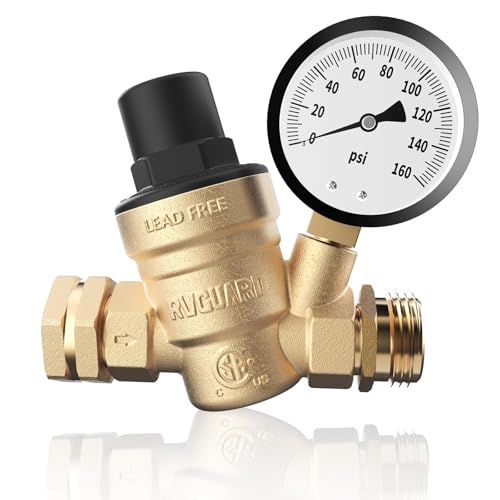 |
RVGUARD Adjustable RV Water Pressure Regulator With Gauge 0, editorial assessment of supplied specifications. Listed lead-free brass construction, adjustable pressure, gauge, inlet screen, and CSA approval claim. Best general-purpose shortlist choice. |
Buy Now |
|
Premium
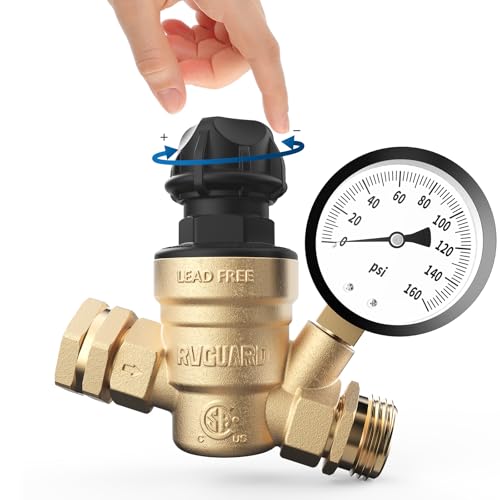 |
RVGUARD Tool-Free Adjustable Knob RV Water Pressure Regulator 0, editorial assessment of supplied specifications. Listed lead-free brass construction, tool-free adjustment knob, gauge, inlet screen, and CSA approval claim. Best for frequent hookups. |
Buy Now |
|
Best Seller
 |
STMOUTUO Adjustable RV Water Pressure Regulator 0, editorial assessment of supplied specifications. Listed lead-free brass construction, adjustable pressure control, gauge, and NSF 372 compliance claim. Conditional value choice pending documentation and price checks. |
Buy Now |
1. RVGUARD RV Water Pressure Regulator Valve With Gauge And Inlet Screen
Key Features That Stand Out
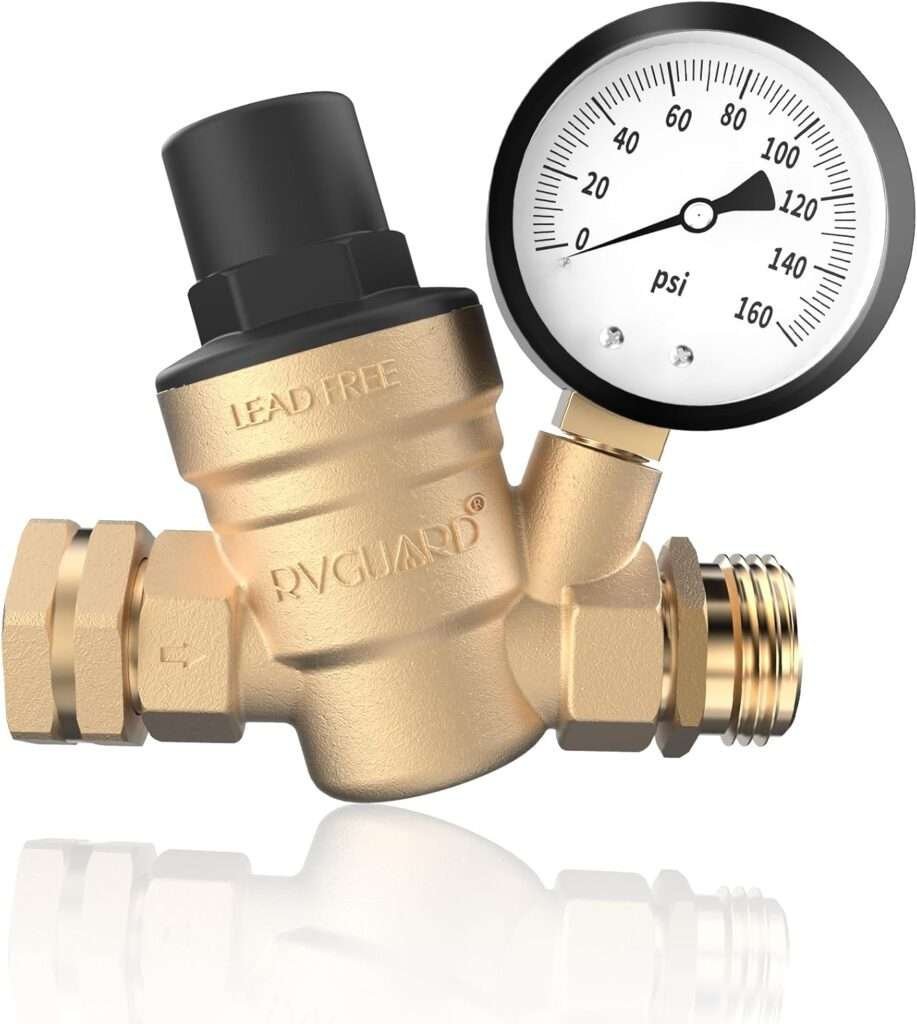
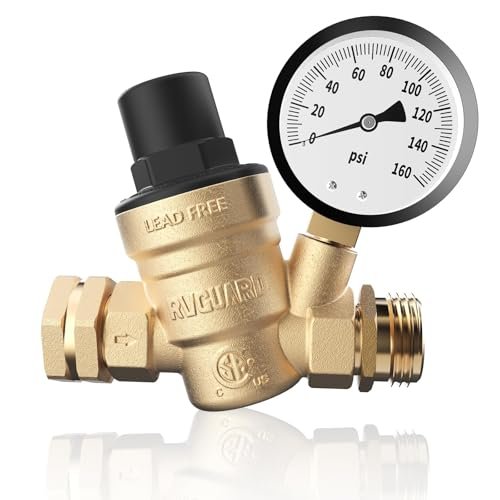
RVGUARD RV Water Pressure Regulator Valve With Gauge And Inlet Screen — here are the features that make it worth your attention:
- Lead-free brass body: The supplied listing identifies brass construction and a lead-free claim. Brass is a practical material for threaded outdoor plumbing hardware because it offers useful strength and dimensional stability. I would still verify the exact model’s drinking-water documentation rather than assuming that every brass component has equivalent material credentials.
- Adjustable pressure control: This model allows pressure adjustment instead of restricting you to an undisclosed fixed setting. That flexibility helps match the regulator to the RV manufacturer’s specified operating pressure. The supplied information does not establish its complete adjustment range, so confirm that range before purchasing.
- Integrated pressure gauge: A visible gauge makes setup more informative than using an uninstrumented reducer. It can help you notice pressure changes and compare static readings with readings during water use. Gauge accuracy, calibration tolerance, and replacement availability are not established by the supplied description.
- Inlet screen filter: The listed screen provides a first barrier against larger debris entering the regulator. That can help protect the valve mechanism from grit, but it does not make campground water microbiologically safe. Treat it as a serviceable debris screen, not a drinking-water treatment system.
- CSA approval claim: The product title states CSA approval. That is a useful reason to request documentation, not enough information to identify the applicable standard or its scope. Match any certificate or directory entry to the exact model and determine whether it addresses pressure performance, drinking-water suitability, or another requirement.
Why Recommended
- Balanced feature package: I place this model on the general-purpose shortlist because adjustable control, a pressure gauge, and an inlet screen address three common needs without relying on accessory claims. It offers a sensible specification baseline for owners who want to understand their water connection rather than simply attach an anonymous reducer.
- Better setup visibility: The gauge gives owners a way to observe what happens after connecting to a new pedestal. That visibility supports safer setup, provided the gauge reads downstream pressure as expected and its reading is trustworthy. Confirm the gauge arrangement in the instructions.
- Practical maintenance focus: A serviceable inlet screen is useful at campgrounds where sediment appears after line work or seasonal startup. Cleaning the screen can restore flow when debris is the cause. It does not correct a damaged valve, an undersized passage, or a clogged downstream filter.
- Conditional drinking-water suitability: The lead-free brass claim is preferable to unspecified metal construction for a potable-water connection. My recommendation remains conditional on documentation, intact seals, clean storage, and installation within published limits. No regulator should receive a hygiene endorsement solely because its exterior looks substantial.
Performance Analysis
- Pressure regulation assessment: I did not measure this unit’s outlet stability. My acceptance test would use a reliable downstream reference gauge, follow the manufacturer’s adjustment procedure, and compare readings with fixtures closed and with a faucet running. A large unexplained rise after flow stops would require investigation before connecting valuable plumbing.
- Flow assessment: A gauge-equipped regulator can still restrict shower flow. I would compare timed bucket fills under the same inlet conditions, first establishing a safe baseline and then checking the regulated setup. Without a published flow curve or controlled measurements, I cannot rank this model above the others for usable flow.
- Leak and handling assessment: I would inspect the hose washer, align the connections without forcing them, and check every joint under pressure. A regulator that hangs from a short or awkward campground faucet can add leverage. Supporting the assembly and avoiding unnecessary adapters reduces stress on the connection.
- Cleaning and durability assessment: The useful ownership checks are screen inspection, clean hose-end handling, and protection from freezing. I have no long-term corrosion or cycle-test results for this model. Drain and store it according to its instructions, and replace damaged seals rather than compensating with excessive tightening.
Best For
“To help you choose the right protection, I’ve put together a detailed guide covering PSI levels, regulator setup, and what to look for when buying an RV water pressure regulator. Read our RV Water Pressure Regulator: PSI, Setup & Buying Guide for more details.”
2. RVGUARD RV Water Pressure Regulator Valve With Tool-Free Adjustable Knob
Key Features That Stand Out
RVGUARD RV Water Pressure Regulator Valve With Tool-Free Adjustable Knob — here are the features that make it worth your attention:
- Tool-free adjustment knob: The defining feature is pressure adjustment without a separate tool. That is genuinely useful when moving between hookups or making an initial setup in a crowded utility area. It improves access, but it does not establish better regulation accuracy than a different adjustment mechanism.
- Lead-free brass construction: The supplied title describes a lead-free brass valve body. That is a relevant material claim for an RV drinking-water connection. As with the original RVGUARD model, I would verify model-specific documentation and avoid confusing a lead-content statement with comprehensive water-quality protection.
- Built-in pressure gauge: The gauge supports setting and monitoring outlet pressure when installed as intended. Its practical value depends on visibility after the regulator is attached. Before buying, consider whether the campground faucet position and neighboring accessories could leave the dial facing the ground or pressed against a pedestal.
- Inlet screen protection: A listed inlet screen can intercept larger particles before they enter the valve. This matters because grit can interfere with sealing and regulation. Screen cleanliness also affects flow, so a weak shower should prompt inspection of the complete water path rather than an immediate pressure increase.
- Listed CSA approval: The supplied product title includes a CSA approval claim. I would request the relevant standard, certificate, and model match before treating that claim as verified. The convenient adjustment knob does not change the need for documented material suitability and operating limits.
Why Recommended
- Best convenience-oriented design: I give this model the highest editorial score because tool-free adjustment adds a clear usability benefit to the listed gauge-and-screen package. The narrow rating advantage reflects convenience, not measured superiority in flow, surge handling, pressure accuracy, or service life.
- Easier repeatable setup: An accessible knob can make owners more likely to check and set pressure when changing campsites. That is useful behavior. The correct routine still includes consulting the RV manual, opening water slowly, checking leaks, and observing the system during actual demand.
- Useful for shared RV duties: When more than one person handles hookups, an obvious adjustment control can reduce confusion about which part changes pressure. I would keep the instructions with the water equipment and mark the preferred setting in a setup checklist rather than relying on memory.
- Less dependence on a tool kit: Avoiding a separate adjustment tool simplifies arrival-day tasks. That convenience is particularly helpful in rain or tight spaces, but owners should never force the knob or assume its direction of travel. Follow the supplied operating instructions.
Performance Analysis
- Adjustment assessment: I have not measured knob effort, adjustment resolution, or setting retention. My practical check would confirm that small adjustments produce predictable downstream changes and that the setting remains stable through several normal draw-and-stop cycles. A larger knob alone cannot prove finer pressure control.
- Dynamic pressure assessment: I would observe the gauge while running a shower and then adding a second fixture. Some pressure drop is normal as demand increases. Excessive sag could originate in the regulator, hose, filter, campground supply, or a partially closed valve, so troubleshooting must isolate each component.
- Installation assessment: The knob needs clearance as well as the gauge. I would check the full assembly before tightening, ensuring that neither control contacts the pedestal or bears the weight of other equipment. A convenient design loses its advantage when installed where the user cannot safely reach it.
- Long-term ownership assessment: I cannot confirm resistance to accidental adjustment, ultraviolet exposure, freezing damage, or repeated transport impacts. Protect the knob and gauge during storage, inspect the assembly before each trip, and recheck pressure after reconnecting rather than assuming the previous setting remains correct.
Best For
3. STMOUTUO RV Water Pressure Regulator Valve With Adjustable Control And Gauge
Key Features That Stand Out
STMOUTUO RV Water Pressure Regulator Valve With Adjustable Control And Gauge — here are the features that make it worth your attention:
- Listed lead-free brass body: The supplied title identifies lead-free brass construction. That gives shoppers a material claim to investigate rather than leaving the metal unspecified. Confirm the applicable documentation, because the appearance and weight of brass do not reveal the lead content or suitability of every wetted component.
- NSF 372 compliance claim: The listing states compliance with NSF 372 standards. NSF/ANSI/CAN 372 addresses lead-content requirements; it does not by itself establish comprehensive drinking-water extraction performance, pressure regulation quality, or contaminant removal. A compliance statement is also not automatically proof of independent certification.
- Adjustable pressure regulation: The supplied description presents an adjustable reducer with a gauge. That is the right basic category for owners who need to match a manufacturer’s pressure specification. The exact adjustment mechanism, usable range, and maximum inlet pressure require confirmation in current documentation.
- Gauge-equipped format: The included gauge offers feedback that a basic ungauged reducer lacks. It should help with setup if readable and reasonably accurate. I would compare it with a known reference before relying on a small difference between the displayed pressure and an RV’s stated limit.
- RV-oriented application: The title identifies travel trailers, motorhomes, and caravans as intended applications. That does not guarantee compatibility with every hose arrangement or onboard inlet. Confirm thread standard, flow direction, operating temperature, dimensions, and any required washers before connecting it.
Why Recommended
- Potential value alternative: I include the STMOUTUO as a conditional comparison option, not a proven bargain. Without current prices, I cannot say it costs less than either RVGUARD. Its value depends on the actual delivered price, documentation quality, warranty, and performance after installation.
- Relevant lead-content emphasis: Mentioning NSF 372 directs attention to an important drinking-water material issue. I prefer a specific, checkable claim over vague language such as safe metal. The buyer should still request evidence and understand exactly what the cited standard does and does not cover.
- Core pressure-control features: Adjustable regulation and a gauge address the essential task more directly than decorative accessories. If verified specifications and commissioning checks are satisfactory, those features can support a useful RV setup without requiring a premium accessory bundle.
- Clear reasons to compare carefully: This model earns a lower editorial score because the supplied information leaves important ownership questions unresolved, including screen provision, detailed pressure ratings, and service support. That score reflects evidence completeness, not a demonstrated mechanical defect or a measured failure.
Performance Analysis
- Documentation assessment: I have not independently verified its NSF 372 claim or tested the metal composition. Before use, I would request a certificate or other credible conformity documentation tied to the exact model. If a seller supplies only a generic statement, I would not treat that as equivalent to a searchable certification record.
- Pressure and flow assessment: I would check stable downstream pressure, pressure recovery after closing a fixture, and usable flow during a shower. No supplied test data establish how this regulator compares with the RVGUARD units. Similar external layouts do not prove identical internal valves or flow capacity.
- Debris-management assessment: The provided title does not establish an inlet screen, so I would inspect the actual package and instructions rather than assuming one exists. If absent, any upstream debris protection must be potable-water compatible and remain within the pressure ratings of all exposed components.
- Reliability assessment: I have no validated endurance, freeze-resistance, or leak-rate results for this unit. My initial checks would include washer condition, thread engagement, gauge behavior, and leakage under normal use. A regulator that creeps upward or behaves inconsistently should be removed from service until the cause is resolved.
Best For
Your Guide To Buying water pressure regulator for rvs
Documented Pressure Range And Stable Regulation
Look for a published maximum inlet pressure, adjustable outlet range, operating temperature, and clear setup instructions. The outlet range must include the pressure recommended for your RV, with practical room to set it below the system limit. Check whether the manufacturer supplies static and flowing-pressure information. A regulator should settle appropriately when fixtures close; unexplained downstream pressure creep deserves attention. Do not assume that a high gauge scale proves the valve can safely accept that same inlet pressure.
Useful Flow Capacity And Readable Gauge
Pressure and flow are different. A restrictive regulator may show an acceptable reading with every faucet closed yet deliver a disappointing shower when water moves. Look for a flow rating tied to specified inlet and outlet conditions or a useful performance curve. Select a gauge that makes your intended setting easy to read, and consider whether replacement is possible. Where accuracy matters, verify the supplied gauge against a reliable reference rather than treating the printed dial as unquestionable.
Verified Potable-Water Materials
Look for documentation covering the exact model and relevant wetted components. Lead-free wording is important, but it does not mean zero lead or complete protection against every substance that could migrate into water. NSF/ANSI/CAN 372 addresses lead content, while NSF/ANSI/CAN 61 addresses drinking-water system component health effects within its applicable scope. A CSA claim also needs its associated standard and model identification. Check independent directories when certification is claimed, and distinguish certified from manufacturer-stated compliant.
Serviceable Screen, Seals, And Connections
An accessible inlet screen helps manage larger particles that can interfere with valve operation. Replaceable washers and clear maintenance instructions make ownership easier. Confirm the correct hose-thread connections rather than relying on an adapter chain assembled by trial and error. Check gauge clearance, adjustment access, and flow direction. The ideal regulator is not merely easy to attach; it is easy to inspect, drain, clean as directed, and store without contaminating the ends.
Important Materials
Brass is common in RV pressure regulators because it combines useful strength, machinability, and compact construction. Its suitability for drinking water depends on the alloy and the complete wetted assembly, not its yellow color. A lead-free brass claim should be supported by appropriate documentation, and owners should avoid assuming that coatings or plating eliminate questions about the underlying material. Stainless steel can offer strong corrosion resistance, but alloy grade, manufacturing quality, seals, and certification still matter. Engineered polymer components can reduce weight and sometimes cost, although outdoor temperature exposure, impact resistance, and thread durability depend on the particular design. Internal diaphragms, O-rings, gauge connections, and washers deserve attention alongside the main body. A heavy metal exterior cannot compensate for unsuitable seals or poor valve construction. For these three products, the supplied titles identify brass, but they do not provide enough detail to compare internal materials or corrosion performance. I would prioritize documented drinking-water suitability, replaceable wear parts, and a clear warranty over assumptions that one material category always lasts longer.
Essential Factors
For a regulator, the useful equivalents of thickness, weight, and stability are body construction, assembly weight, mounting leverage, and pressure stability. More mass is not automatically better: a heavy valve, gauge, filter, and rigid adapter stack can put substantial strain on a campground faucet. Arrange the system so components do not hang unsupported or force the hose into a sharp bend. Confirm the regulator’s flow direction and connection type, and leave room to read the gauge without twisting the assembly under pressure. Place pressure-sensitive equipment downstream of regulation unless the manufacturer’s instructions specify a different safe arrangement; any component left upstream must tolerate the supply pressure. Check your RV manual before selecting a setting. Many owners encounter guidance around 40 to 50 psi, but that is not a universal specification and should not override a lower limit. Also distinguish city-water connection from gravity tank filling: a regulator controls pressure in a pressurized connection, not the fill level in a vented fresh-water tank. Finally, factor in climate. Freezing trapped water can damage a regulator, and a gauge that survives one winter is not proof of freeze protection.
Budget Planning Guide
| Category | Description | Typical Features |
|---|---|---|
| Budget-Friendly | Often approximately $10 to $25 for the broader RV regulator category, although current prices vary. Suitable for simple protection when the fixed setting, flow capability, and material documentation match the application. These are planning estimates, not verified prices for the reviewed products. | Commonly fixed-pressure designs, compact bodies, limited adjustment, and sometimes no gauge. Check the stated outlet setting, potable-water compatibility, inlet rating, and flow limitations before prioritizing the lowest purchase price. |
| Mid-Range | Often approximately $25 to $60 for adjustable consumer RV models, depending on seller and accessories. This is the category I would investigate first for owners who want gauge feedback and a repeatable setup process without paying for unnecessary bundles. | Adjustable outlet pressure, integrated gauge, brass construction, possible inlet screen, and either a tool-operated adjustment or hand knob. Certification evidence, service parts, and warranty quality can vary substantially within the same price band. |
| Premium | Often approximately $60 to $150 or more for higher-specification assemblies, specialty regulators, or systems with stronger documentation and service support. A higher price is worthwhile only when the additional capabilities address a real need. | Potentially published flow curves, serviceable internals, replaceable gauges, stronger warranty support, or specialized pressure and temperature ratings. None of those features should be assumed from price alone; confirm them in the exact product documentation. |
Final Verdict
For most shoppers comparing these three options, I would start with the RVGUARD tool-free adjustable knob regulator. Its listed combination of a gauge, inlet screen, lead-free brass body, and hand adjustment offers the clearest usability advantage. Choose the original RVGUARD when its current price is more attractive and you do not need tool-free control. Consider the STMOUTUO when the seller can substantiate its material claims and provide operating details that match your RV; do not buy it solely because NSF 372 appears in the title. These are specification-based recommendations, not hands-on durability rankings. Before ordering any water pressure regulator for RVs, verify maximum inlet pressure, usable outlet range, connection compatibility, potable-water documentation, and warranty support. Before relying on it, check the gauge, inspect for leaks, and observe pressure with fixtures both open and closed. The right regulator does not need the most accessories or the heaviest body. It needs to maintain appropriate pressure, pass enough water for normal use, and fit a clean, serviceable connection. Pair it with sound hose handling, suitable filtration where needed, and regular inspection. That combination protects the RV more effectively than treating any single valve as a complete water-safety system.
FAQs About water pressure regulator for rvs
1 Do I need a water pressure regulator every time I connect my RV to city water?
2 What pressure should I set my RV water regulator to?
3 Should the regulator go before or after my RV water filter?
4 Will a water pressure regulator improve a weak RV shower?
5 What is the difference between an adjustable regulator and a fixed-pressure reducer?
6 Does lead-free brass mean the regulator makes water safe to drink?
7 What should I do if pressure slowly rises after I close the faucet?
8 Does an RV regulator protect the onboard water pump?
9 How do I install and check an RV water pressure regulator?
10 Can I leave the regulator outside, and how should I store it?
11 Which of these three regulators is the best choice?