
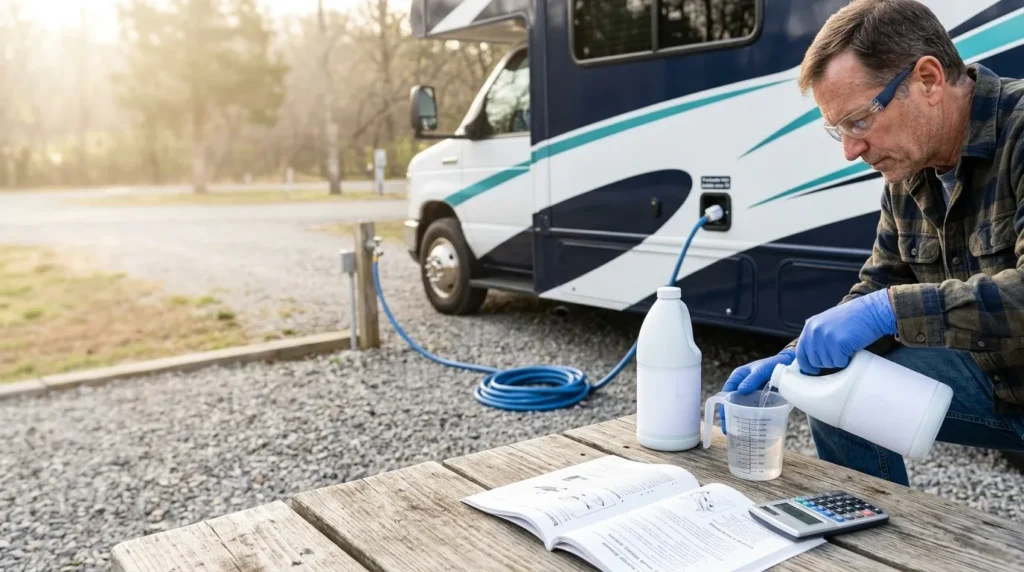
For an RV fresh-water tank in the United States, a commonly used sanitizing dose is 1/4 US cup of regular, unscented household bleach for every 15 US gallons of tank capacity. That equals 2 fluid ounces per 15 gallons. Use this ratio only when it matches your RV manufacturer’s instructions and the bleach strength those instructions specify.
For example, a 60-gallon tank needs 1 cup of bleach under this method. Dilute the measured bleach with water before adding it, fill the tank with potable water, distribute the solution through the approved plumbing, and leave it for the manufacturer’s required contact time—commonly at least four hours for this particular method.
This is a maintenance procedure for an RV’s fresh-water system, not a recipe for treating drinking water. Do not drink the sanitizing solution, and do not apply this dose to gray-water or black-water tanks.
How Much Bleach Does Your RV Fresh-Water Tank Need?
Calculate the dose from the fresh-water tank’s rated capacity, using the ratio specified in your RV manual. If your manual calls for 1/4 cup per 15 gallons, use the following table.
RV water tank bleach dosage chart
These amounts assume the tank will be filled to its rated capacity after the diluted bleach is added.
| Fresh-water tank capacity | Bleach in US cups | Bleach in US fluid ounces |
|---|---|---|
| 15 gallons | 1/4 cup | 2 fl oz |
| 20 gallons | 1/3 cup | 2.7 fl oz |
| 30 gallons | 1/2 cup | 4 fl oz |
| 40 gallons | 2/3 cup | 5.3 fl oz |
| 45 gallons | 3/4 cup | 6 fl oz |
| 50 gallons | 5/6 cup | 6.7 fl oz |
| 60 gallons | 1 cup | 8 fl oz |
| 75 gallons | 1 1/4 cups | 10 fl oz |
| 80 gallons | 1 1/3 cups | 10.7 fl oz |
| 100 gallons | 1 2/3 cups | 13.3 fl oz |
The decimal fluid-ounce values are rounded. Use a marked measuring container rather than estimating an unfamiliar cup fraction.
The calculation
For this dosing method:
Bleach in cups = tank capacity in gallons ÷ 60
Or:
Bleach in fluid ounces = tank capacity in gallons × 0.1333
For a hypothetical 54-gallon fresh-water tank:
- 54 ÷ 60 = 0.9 cup
- 54 × 0.1333 = 7.2 fluid ounces
Use the fresh-water tank specification—not the RV’s combined fresh, gray, and black tank capacities. Do not include water-heater capacity unless the manufacturer’s procedure tells you to calculate the dose that way.
A full-tank dose requires a full-tank dilution. Putting the bleach calculated for a 60-gallon tank into only 15 gallons of water creates a substantially stronger solution and does not expose the entire tank interior.
Which Bleach Is Suitable, and Does Strength Matter?
Use the bleach type and concentration specified by your RV manufacturer. Regular, unscented household bleach is the usual choice; “splashless,” scented, gel, and cleaner-blend products should not be treated as interchangeable substitutes.
Check the label for:
- Active ingredient: sodium hypochlorite.
- Concentration: the percentage of sodium hypochlorite.
- Formulation: plain bleach without fragrance or added cleaning agents.
- Condition: a reasonably fresh product stored according to its label.
The familiar 1/4-cup-per-15-gallon method is commonly associated with older household bleach formulations around 5%–6%. A bottle labeled 7.5% or 8.25% delivers more active ingredient per measured cup. That difference can change the appropriate dose.
The EPA’s emergency drinking-water guidance also distinguishes bleach concentrations and excludes products with unsuitable additives. However, its drinking-water treatment doses are not RV tank-sanitizing instructions.
Can you adjust the dose for stronger bleach?
A proportional calculation can compare strengths, but it does not replace an approved RV sanitizing procedure.
If the manufacturer explicitly bases its recipe on a particular concentration and permits equivalent-strength substitution:
Adjusted bleach volume = specified volume × specified concentration ÷ actual concentration
For example, if an approved procedure specifies 1 cup of 5.25% bleach, the approximate equivalent amount of 8.25% bleach is:
1 cup × 5.25 ÷ 8.25 = 0.64 cup, or approximately 5.1 fluid ounces.
This is a concentration-scaling estimate, not a new independently validated sanitizing recipe. If the manual does not identify the intended bleach strength or address substitutions, ask the RV manufacturer before using a concentrated product.
How to Sanitize an RV Water Tank Step by Step
Sanitize the tank and the connected plumbing covered by your manufacturer’s procedure, then drain and thoroughly flush the system. Treating the tank alone can leave untreated water in faucets and branch lines.
1. Check the instructions and gather supplies
Before starting, find the fresh-water sanitizing section in your model’s owner’s manual. Manufacturer resources, such as Winnebago’s operator manuals, are the appropriate place to confirm model-specific instructions.
You will generally need:
- The approved bleach.
- A measuring container reserved for chemical use.
- A clean container for diluting the bleach.
- A potable-water hose and safe water supply.
- Gloves and eye protection appropriate to the product label.
- An approved location for draining the solution.
Identify any carbon filters, reverse-osmosis equipment, ice makers, water dispensers, and water-heater bypass valves before you begin. Their instructions may require removal, isolation, or a separate sanitizing procedure.
2. Turn off the water heater and drain the system as directed
Turn off both electric and propane water heating. Let hot water cool, disconnect pressurized water supplies, and relieve pressure before opening a heater drain or removing a plug.
Drain the fresh-water tank and the other components specified by the manual.
Do not turn on a water heater while it is empty. Whether the heater should receive the sanitizing solution or remain bypassed depends on the RV and heater instructions.
3. Measure and dilute the bleach
Measure the amount required for the tank capacity and approved bleach concentration. Mix it with water in a clean container before introducing it into the RV.
Do not pour concentrated bleach directly onto tank fittings or leave it sitting undiluted in the system. Follow the approved fill method; some RVs use a gravity-fill opening, while others require a designated sanitizing or winterizing inlet.
4. Fill the tank with potable water
Add enough potable water to reach the fill level required by the procedure—normally a full fresh-water tank for the dosing table above.
Do not sanitize with water from a questionable source. Dirty water can consume chlorine and introduce additional contamination.
5. Distribute the solution through the plumbing
Use the onboard pump to draw treated water through each fixture included in the procedure. Run one outlet at a time until the sanitizing solution reaches it, then close it.
Check applicable outlets such as:
- Kitchen and bathroom faucets.
- Interior and exterior showers.
- Toilet supply lines.
- Other potable-water branches.
Run hot-water lines only in the configuration authorized by the manual. A bypassed water heater does not become sanitized simply because treated water passes through the bypass plumbing.
6. Allow the required contact time
For the common 1/4-cup-per-15-gallon method, the specified contact period is often at least four hours. Confirm the exact requirement in your manual.
Start timing after the solution has reached the components being treated. Do not shorten the waiting period because the chlorine smell seems strong, and do not increase the dose to speed up the process.
If your manufacturer specifies a different dose and contact time, follow that complete procedure rather than mixing parts of different methods.
7. Drain and flush
Drain the sanitizing solution at an authorized location. Refill with potable water, run clean water through the treated branches, and drain again as instructed.
Repeat flushing if a strong bleach odor remains. Restore filters, valves, and other components only as directed, and confirm that the water heater is full before restoring heat.
How to Tell Whether Sanitizing Worked
A successful maintenance cycle requires correct dosing, complete distribution, adequate contact time, and thorough flushing. Chlorine smell alone does not prove that the system is sanitary.
Before returning the system to use, confirm that:
- Every intended branch received the solution.
- The full required contact period elapsed.
- The system was drained and flushed with potable water.
- Valves and filters are back in their operating configuration.
- Faucets run normally without a strong bleach odor.
- No leaks appeared during the process.
A chlorine test kit can help assess remaining chlorine, provided it measures the correct parameter and range. It does not prove that harmful microorganisms or chemical contaminants are absent.
What if the bleach smell will not go away?
Check for trapped treated water before adding anything else. Possible causes include a tank that did not drain completely, an overlooked branch line, or a component holding sanitizing solution.
Flush the affected components according to their instructions. Persistent odor, discoloration, slime, or recurring contamination warrants investigation rather than repeated guesswork with bleach.
Do not add vinegar, ammonia, toilet cleaner, or another chemical to “neutralize” the bleach. The CDC’s bleach safety guidance warns against mixing bleach with other cleaners or disinfectants because hazardous vapors can result.
Common Mistakes and Safety Limits
More bleach is not a substitute for cleaning, adequate contact time, or a properly maintained water system. Avoid these errors:
| Mistake | Why it matters | Better approach |
|---|---|---|
| Using the wrong tank capacity | Produces the wrong dilution | Use the fresh-water specification in the manual |
| Using concentrated bleach without checking strength | Changes the dose substantially | Confirm the approved concentration |
| Dosing for a full tank but filling it only partly | Creates a stronger solution and incomplete tank coverage | Follow the required fill level |
| Leaving carbon filtration in the treatment path | Carbon can remove chlorine | Follow filter-removal or bypass instructions |
| Sanitizing only the tank | Leaves plumbing untreated | Treat every approved branch |
| Assuming odor proves safety | Smell cannot verify microbial removal | Complete the full documented procedure |
| Leaving bleach in longer than instructed | Adds unnecessary material exposure | Use the specified contact time |
When routine sanitizing is not enough
Stop using the system for drinking and seek appropriate guidance if it may contain:
- Fuel, pesticides, or another chemical contaminant.
- Floodwater or sewage.
- Heavy deposits or persistent visible growth.
- Contamination associated with repeated illness.
Bleach does not make chemically contaminated water safe. An RV service technician can investigate plumbing and component problems; a local health department or qualified water-testing laboratory can advise on contamination testing.
Where should the bleach solution go?
Follow campground rules and local wastewater requirements. Ask whether the facility accepts the solution through its sanitary disposal system.
Do not discharge chlorinated water into a storm drain, creek, lake, or landscaped area. Do not assume disposal into a septic system is acceptable without the operator’s guidance.
FAQs
How often should you sanitize an RV fresh-water tank?
Follow your manufacturer’s schedule. Sanitizing is commonly part of returning an RV to service after storage, but the required frequency depends on use and the manufacturer’s guidance. Also investigate suspected contamination, unusual odors, and work that exposes the potable-water system.
Do you need to sanitize when using campground city water?
City water does not make RV plumbing self-cleaning. Depending on the valve arrangement, city water may also bypass the fresh-water tank. Maintain both the tank and distribution plumbing according to the RV’s instructions.
Can you use pool chlorine instead of household bleach?
Do not substitute pool chemicals unless the RV manufacturer explicitly authorizes a particular product and procedure. Pool products differ in concentration, form, and additives and are not interchangeable with the measured household-bleach recipe.
Will bleach remove mineral scale from the tank?
Bleach is a disinfectant, not a mineral-scale remover. Mineral deposits may need a separate, manufacturer-approved cleaning procedure. Never combine an acidic descaler with bleach.
Can you drive the RV to help mix the sanitizing solution?
Driving is not a substitute for filling the tank properly, circulating solution through the plumbing, or allowing the required contact time. Only use a driving or agitation step if the manufacturer recommends it.
Conclusion
For the commonly used RV sanitizing method, measure 1/4 cup of approved regular bleach per 15 gallons of fresh-water tank capacity—equivalent to 1 cup for a 60-gallon tank. Confirm the bleach strength and procedure in your exact RV manual before measuring.
Then dilute, fill, circulate, wait for the required contact time, drain, and flush. Your next step is to locate three facts: tank capacity, approved bleach concentration, and required contact time.
Evidence and Editorial Scope
This guide supports one task: calculating and safely applying a maintenance sanitizing dose for a US RV fresh-water system. No site map was supplied, so no parent or neighboring pages are assigned.
Research limitation: Live browsing was unavailable. The linked resources are reference destinations, not pages verified during this drafting session. No current search rankings, competitor findings, hands-on testing, or model-specific approvals are claimed. Your exact RV manual and bleach label control the procedure.
The next-question map below records practical follow-up needs inferred from the task, not verified search demand.
| Next question | Reader stage and basis | Competitor coverage | Reader benefit and evidence needed | Priority and placement |
|---|---|---|---|---|
| Does stronger bleach change the amount? | Before dosing; inferred from differing label concentrations | Not checked | Avoid an incorrect dose; verify manual and label | High; bleach-strength section |
| Should the water heater be bypassed? | Before circulation; inferred from system configurations | Not checked | Avoid incomplete treatment or equipment errors; verify RV and heater manuals | High; procedure |
| Does chlorine smell prove sanitation? | After contact time; inferred from a likely success check | Not checked | Prevent false reassurance; use documented procedure and testing guidance | High; success section |
| What if contamination is chemical or sewage-related? | Before reuse; inferred safety boundary | Not checked | Avoid using routine maintenance as a universal remedy; obtain public-health guidance | High; safety limits |