
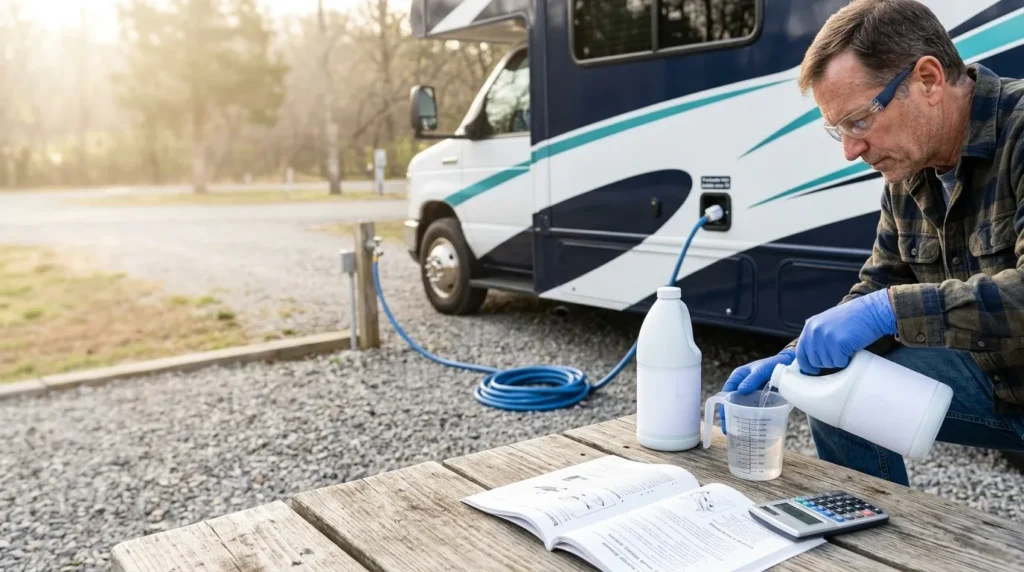
Quick answer for RVs in the United States: Use 1/4 cup of regular, unscented household bleach (5–6% sodium hypochlorite) for every 15 gallons of fresh water tank capacity. That dose yields roughly 50–100 ppm free chlorine, which is a common sanitizing level recommended by major RV manufacturers. Let the chlorinated water sit in the system for 4–8 hours, then drain and flush until the chlorine smell is very faint. If your bleach is 8.25% strength, use about 3/4 as much by volume.
Bleach must be plain, unscented, and not “splashless,” gel, or “outdoor.” After sanitizing, flush until residual chlorine is below the US EPA’s drinking-water maximum residual disinfectant level of 4.0 ppm. Replace or bypass any carbon filters during the process, and check your RV owner’s manual for model-specific notes.
The Right Amount of Bleach: Formula, Chart, and Examples
- Standard dose (5–6% bleach): 1/4 cup per 15 gallons
- Equivalent formula:
- Cups of bleach (5–6%) = Tank gallons ÷ 60
- Fluid ounces of bleach (5–6%) = Tank gallons × 0.133
- Milliliters of bleach (5–6%) ≈ Tank gallons × 3.94
- Adjusting for other strengths:
- If using 8.25% bleach: volume × (6 ÷ 8.25) ≈ × 0.73
- If using 5.25% bleach: volume × (6 ÷ 5.25) ≈ × 1.14
Quick chart (standard US household bleach at 5–6%):
- 20 gal tank: 1/3 cup (2.7 fl oz; ~79 mL)
- 30 gal: 1/2 cup (4.0 fl oz; ~118 mL)
- 40 gal: 2/3 cup (5.3 fl oz; ~158 mL)
- 50 gal: 5/6 cup (6.7 fl oz; ~197 mL)
- 60 gal: 1 cup (8.0 fl oz; ~237 mL)
- 75 gal: 1-1/4 cups (10.0 fl oz; ~296 mL)
- 100 gal: 1-2/3 cups (13.3 fl oz; ~394 mL)
Example calculation (5–6% bleach):
- 48-gallon tank: 48 ÷ 60 = 0.8 cups ≈ 3/4 cup plus 1 tablespoon
- 33-gallon tank: 33 ÷ 60 = 0.55 cups ≈ 1/2 cup plus 1 tablespoon
Why this works: That dose produces about 50–100 ppm free chlorine in the tank—enough for shock sanitization of potable water plumbing without damaging typical RV materials when contact time is limited to hours, not days.
What “Bleach” Means Here—and US Safety Benchmarks
- Use only plain, unscented household bleach labeled 5–9% sodium hypochlorite. In the US, most “concentrated” bleaches are 6–8.25%.
- Avoid splashless, thickened, scented, color-safe, or “outdoor” formulas; additives can leave residues and are not intended for potable systems.
- EPA drinking water benchmark: Flush the RV system until residual chlorine is below 4.0 mg/L (ppm), which aligns with the US EPA Maximum Residual Disinfectant Level for municipal tap water.
- Taste and odor: Many US water utilities deliver 0.2–4.0 ppm chlorine. After proper flushing, your RV water should smell at most faintly chlorinated—similar to city tap water.
Note on vinegar: White vinegar helps dissolve mineral scale, but it is not a US-approved disinfectant for potable water systems. Use bleach (sodium hypochlorite) or a chlorine-dioxide product specifically labeled for drinking water systems if you prefer a non-bleach option. Follow the product’s US directions.
Step-by-Step: How to Sanitize an RV Fresh Water System safely
prerequisites
– Know your fresh tank capacity (owner’s manual, label, or measure).
- Plain unscented household bleach (5–6% preferred; 8.25% ok with adjustment).
- Clean water source (US municipal tap water is fine).
- Funnel or winterizing siphon hose; a clean bucket or jug for pre-dilution.
- Optional: chlorine test strips (0–200 ppm range and a 0–10 ppm range), nitrile gloves, eye protection.
- Bypass or remove carbon filters so they don’t absorb the sanitizer and get ruined.
Steps
- Turn off and cool the water heater
- Switch off electric and propane. If your RV has a bypass, you may bypass to save bleach; it’s also fine to sanitize the heater with the system. If bypassed, sanitize the heater separately later.
- Calculate and pre-dilute bleach
- Use the formula above. Pre-dilute the measured bleach in 1–2 gallons of clean water per 1/2 cup of bleach. Pre-dilution reduces the risk of localized high concentration on fittings and helps distribute it faster.
- Add bleach to the fresh water tank
- Gravity fill: pour the diluted bleach into the fill port with a funnel, then begin filling the tank with water.
- Winterizing siphon or pump: insert the hose into the diluted bleach container and use the pump to draw it in, then finish filling.
- Fill the tank completely with potable water
- A full tank ensures maximum contact on all internal surfaces.
- Circulate through all lines
- Turn on the water pump. One fixture at a time, open cold until you smell chlorine, then open hot until you smell chlorine. Do sinks, shower, toilet, exterior shower, and appliances (washer, fridge water dispenser/ice maker) per manufacturer guidance. Close each after chlorinated water reaches it.
- Contact time
- Let the system sit for 4–8 hours. Overnight is common. Do not exceed 24 hours.
- Drain and flush
- Drain the fresh tank and water heater (if included). Refill with fresh water and run each fixture until the chlorine smell drops to faint. You may need 1–2 full tank flushes.
- Verify and restore
- Optional: Use a low-range chlorine strip to confirm residual <4 ppm. Reinstall or replace carbon filters. Return water heater to normal and purge air before powering it.
Signs of success
- Initial strong chlorine odor at fixtures during step 5.
- After flushing, only a faint chlorine smell (or none), clear water, no slime, no off-odors.
If the process fails
- Persistent odor/slime: Repeat at the same dose for 8 hours, or use the high end of the contact time range. Inspect hoses for biofilm, replace old carbon filters, and ensure the water heater and low-point drains were included.
Variables That Change the Dose or Method
-
Bleach strength:
- 8.25%: Use ~73% of the 5–6% volume.
- 5.25%: Use ~14% more than the 5–6% volume.
-
Water heater choice:
- Bypass to save bleach and time, but sanitize the heater at least seasonally by filling it with 50–100 ppm chlorinated water for 4–8 hours, then draining and flushing thoroughly.
-
Filters and softeners:
- Remove or bypass carbon filters and RO membranes before sanitizing; replace carbon filters after. Sediment filters can be rinsed or replaced.
-
Storage and use pattern:
- Sanitize at the start of the US camping season, after any long storage, after questionable fills (non-municipal sources), and when taste/odor appears. Many US owners sanitize every 3–6 months.
-
Unknown tank size:
- Check the US owner’s manual, the tank label, or fill via known 5-gallon increments or an inline flow meter until water exits the overflow; record the volume.
Common Mistakes, Limits, and Safety Boundaries
- Using scented or splashless bleach: Additives can foam, coat surfaces, and leave residue. Stick to plain, unscented bleach only.
- Overdosing: More is not better. Stay near 50–100 ppm. Very high chlorine can damage rubber components and stainless finishes over time.
- Extended contact time: Do not leave strong bleach in the system for days. Limit to 4–8 hours (up to 24 hours maximum).
- Mixing chemicals: Never combine bleach with ammonia, vinegar, or acids. Dangerous gases can form.
- Skipping the hot side or appliances: Open both hot and cold at every fixture you plan to use; include toilet and outdoor shower.
- Forgetting the water heater: If bypassed, sanitize it separately on a schedule.
- Dumping to storm drains or surface water: In the US, discharge chlorinated water to a sanitary sewer or RV dump station. Do not release to storm drains, streams, or lakes. On a campsite without sewer, disperse small amounts onto gravel per park rules—away from plants and waterways.
Troubleshooting: Odors, Taste, Cloudiness, and Biofilm
Symptom: Persistent bleach taste after multiple flushes
- Likely cause: Residual chlorine above your taste threshold or carbon filter not reinstalled.
- Fix: Refill and flush again; confirm residual <4 ppm. Reinstall or replace carbon filters, which remove chlorine taste effectively.
Symptom: Rotten-egg or musty odor returns quickly
- Likely cause: Biofilm in lines or heater; exhausted carbon filter; contaminated hose or filler port screen.
- Fix: Repeat sanitizing at 50–100 ppm for 8 hours. Sanitize or replace potable-water hoses. Clean the fill port screen. Replace carbon filter. Include the water heater.
Symptom: Slime or discoloration in tank or fixtures
- Likely cause: Algae or bacterial growth from long storage or sun-exposed translucent tank.
- Fix: Full sanitize cycle; consider a light-blocking tank wrap and store with the tank drained.
Symptom: Cloudy water after sanitizing
- Likely cause: Mineral precipitation at high pH or debris loosened from lines.
- Fix: Flush more thoroughly. Consider a fresh sediment cartridge.
When to seek service
- If odors or slime persist after two correct sanitization cycles, have an RV service center inspect for dead-legs, failing check valves, or a contaminated water heater anode and tank.
Maintenance Schedule and Next Steps
- Routine sanitizing: Every 3–6 months for US RV owners, plus after any period of storage or a questionable water fill.
- Between trips: Drain the fresh tank when storing for more than a week. Leave faucets closed and filters dry.
- Hoses and filters: Use only potable-water (“white” or labeled drinking-water safe) hoses. Replace carbon filters every season or per gallons used, and always after a shock sanitize.
- Testing: Keep pool-style chlorine strips in your kit. They’re inexpensive and help confirm both shock levels and safe residuals.
FAQs
How long should bleach sit in an RV fresh water tank?
- 4–8 hours is typical. Overnight is fine. Don’t exceed 24 hours.
Is 1/4 cup per 15 gallons really enough?
- Yes. That produces about 50–100 ppm free chlorine—commonly recommended by US RV makers for shock sanitization without harming plumbing when used correctly.
Can I use 8.25% bleach?
- Yes. Use roughly 73% of the 5–6% volume. Example: If the 5–6% chart says 1 cup, use about 3/4 cup of 8.25%.
Do I have to bypass my water heater?
- No. Many owners sanitize the heater with the system. Bypassing simply reduces bleach needed and flush time. If bypassed, sanitize the heater separately as part of seasonal maintenance.
Is it safe to drink water after sanitizing?
- Yes, after thorough flushing. Confirm the chlorine residual is below 4 ppm, which is consistent with US EPA limits for tap water. Many owners also run water through a carbon filter for taste.
Conclusion
For US RV owners, a simple, evidence-aligned rule works: dose plain unscented 5–6% bleach at 1/4 cup per 15 gallons, circulate through every fixture, hold 4–8 hours, then flush to a faint or no chlorine smell and below 4 ppm residual. Reinstall fresh carbon filters, keep hoses clean, and repeat every 3–6 months—especially after storage or suspect fills.