
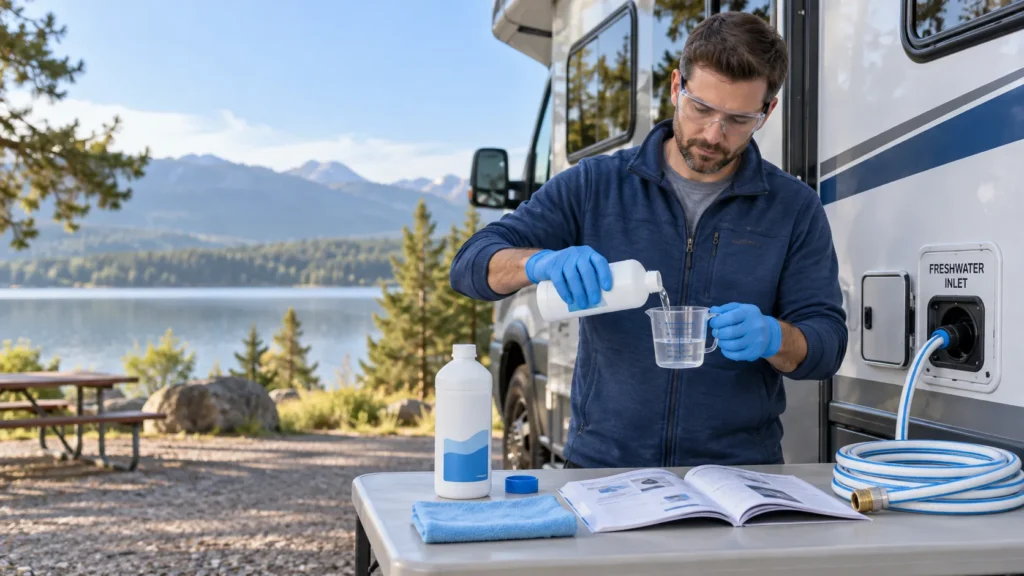
If you’re wondering How Much Bleach Per Gallon To Sanitize RV Tank, my starting point is your RV’s owner’s manual. A common guideline is ¼ cup of plain, unscented household bleach per 15 gallons of freshwater tank capacity—about 0.8 teaspoon per gallon. The correct dose can vary with bleach concentration and your manufacturer’s requirements, so I wouldn’t apply that ratio to every RV.
Before sanitizing, I check the recommended dilution, contact time, and flushing procedure. Use only the bleach type your manufacturer permits, dilute it as directed, and never mix it with other cleaners. This guide covers freshwater tanks and connected potable-water plumbing, not black-water holding tanks.
Introduction: U.S.-based basics for RV water system sanitation
If you travel the United States with an RV, periodic fresh water system sanitation is standard maintenance to keep biofilm, algae, and bacteria from building up—especially after storage, filling from unfamiliar spigots, or noticing off-odors. The most common, cost-effective method American manufacturers and service centers reference is sanitizing with ordinary, unscented household bleach labeled 5–8.25% sodium hypochlorite. The dose that balances effectiveness, material safety, and taste removal aligns with a target of roughly 50–85 parts per million (ppm) free chlorine in the full tank and lines, followed by thorough flushing.
The correct bleach dose (and how to adjust it)
- Standard U.S. rule of thumb for fresh water tanks: 1/4 cup bleach per 15 gallons of tank capacity.
- Per-gallon shortcut: about 3/4 teaspoon bleach per gallon of tank capacity.
- What this produces: approximately 50–85 ppm free chlorine, depending on the bottle’s exact percentage and freshness—sufficient for routine sanitizing with a 4–12 hour contact time before flushing.
Equivalent amounts by common tank sizes (based on 1/4 cup per 15 gallons):
- 10 gallons: ~1/6 cup (about 2.5–3 tbsp; ~8 tsp)
- 20 gallons: ~1/3 cup
- 30 gallons: 1/2 cup
- 40 gallons: 2/3 cup
- 50 gallons: ~5/6 cup
- 60 gallons: 1 cup
- 80 gallons: 1 1/3 cups
- 100 gallons: 1 2/3 cups
Adjusting for different bleach strengths
- If your bleach is 6%: use the amounts above as-is.
- If your bleach is 8.25% (“concentrated”): multiply the above amounts by 0.73 (roughly 3 tbsp per 15 gallons).
- If your bleach is 5.25%: multiply by 0.88 (a little more than the 6% baseline).
Practical formula for any tank size and bleach strength
- Bleach (cups) = (Tank gallons ÷ 15) × 0.25 × (6% ÷ your bleach %)
- Example: 33-gallon tank, 7.5% bleach:
- Cups = (33 ÷ 15) × 0.25 × (6 ÷ 7.5) ≈ 0.44 cup (about 7 tbsp)
Tip: Verify with a 10–200 ppm free-chlorine test strip if you want extra assurance you’re within range.
Step-by-step: Sanitize a U.S. RV fresh water system safely
Prerequisites
- Plain, unscented household bleach (5–8.25% sodium hypochlorite). Do not use splashless, scented, or color-safe formulations.
- Measuring cup/spoons, clean funnel, potable-water-safe hose.
- Optional: water heater bypass, chlorine test strips, gloves, eye protection.
- Remove or bypass any carbon/ceramic drinking water filters to avoid damaging them.
Steps
- Determine tank size and dose
- Find your fresh water tank capacity (owner’s manual or label).
- Calculate bleach needed using the amounts above.
- Bypass the water heater (recommended)
- Engaging the bypass saves bleach and avoids prolonged chlorine contact with heater components. You’ll still sanitize the hot lines later as the solution circulates.
- Mix and add the bleach
- Dilute the measured bleach in a clean container with at least a gallon of water. Pour into the freshwater fill using a funnel.
- Fill the tank completely with potable water.
- Circulate through every line
- Turn on the water pump.
- Open each cold faucet/shower, outside shower, and toilet valve until you smell chlorine; close.
- Repeat for hot side fixtures (you’re pulling sanitized water through hot lines even with the heater bypassed).
- Contact time
- Let the system sit 4–12 hours (overnight is common), but avoid exceeding 24 hours.
- Drain and flush thoroughly
- Drain the fresh tank. Refill with potable water and flush each fixture until the chlorine smell is faint to gone.
- Repeat a second full-tank flush if needed.
- Restore the water heater from bypass, drain/flush the heater if desired, then open hot fixtures to refresh.
- Reinstall filters and return to service
- Replace or reinstall point-of-use filters only after chlorine smell is gone.
Signs of success
- No musty or sulfur odors.
- Clear water without visible sediment/slime.
- Chlorine test in the lines near zero after final flushing (or no perceptible odor/taste).
Variables that change the dose or timing
- Bleach strength and freshness: Newer bleach is stronger. If your bottle is old or stored warm, it may have lost potency—consider modestly increasing the dose or confirming with a test strip.
- Biofilm severity: Heavy slime or strong sulfur odors may need the upper end of contact time (12–24 hours) and a repeat cycle, rather than a stronger single dose.
- Temperature: Warmer water accelerates disinfection but can also speed bleach degradation in storage. Room-temperature fills are fine.
- Materials compatibility: Short-term exposure to 50–85 ppm is generally compatible with PEX, vinyl, and typical RV pump components. Avoid routinely exceeding ~200 ppm, which increases the risk to seals and metallic parts.
- Water heater handling: Many owners bypass to avoid prolonged chlorine in the tank. If you have persistent odors from the heater, flush it separately and only briefly circulate a sanitizing solution through it.
What about gray and black tanks?
- Black tank: Routine bleach use isn’t recommended. Repeated exposure can degrade rubber seals, affect valve lubrication, and reduce effectiveness of enzyme-based treatments. Bleach can also react with residual urine to form irritating gases. Instead, use plenty of water, periodic tank rinsing, and RV-specific cleaners/deodorizers as needed.
- Gray tank: Small, heavily diluted bleach rinses can help with biofilm or odor in drains/hoses, but avoid strong or frequent doses. Enzyme or oxygen-based cleaners, warm water with a mild detergent, and regular flushing are safer long-term practices.
If you do an occasional “shock” clean in the gray tank, favor non-chlorine oxygen cleaners compatible with RV plumbing and follow the product’s dilution and contact-time directions precisely.
Troubleshooting and safety limits
- Chlorine taste/smell won’t go away: Do a second full-tank flush and open every faucet until odor is gone. You can add a small dose of potable-water-safe dechlorinator (aquarium sodium thiosulfate product, per label) to the final rinse. Avoid acidic “neutralizers” like vinegar with any residual bleach—this can release chlorine gas.
- Odor returns quickly: Re-sanitize with full contact time, inspect for contaminated hoses or filters, and confirm your source water. Replace old carbon filters and ensure your fill hose is labeled for drinking water.
- Unsure about ppm: Use a 10–200 ppm chlorine test strip after mixing and circulating. Aim roughly 50–100 ppm during contact time; flush to near-zero for drinking.
- Safety boundaries:
- Never mix bleach with ammonia, vinegar, acids, or other cleaners.
- Ventilate well and wear gloves/eye protection when handling concentrates.
- Do not leave strong bleach solutions in the system beyond 24 hours.
- Use only plain, unscented household bleach (5–8.25% sodium hypochlorite).
FAQs
How often should I sanitize my fresh water system?
At the start of each season, after storage, after using questionable water sources, and any time you notice odor/slime. Frequent travelers who refill from varied U.S. sources often sanitize every 1–3 months.Is bleach safe for PEX plumbing and RV water pumps?
At ~50–85 ppm for under 24 hours, this is commonly used by U.S. RV manufacturers and service centers. Avoid stronger mixes or extended soaks to protect seals and metals.Can I sanitize with vinegar instead?
Vinegar can help descale mineral buildup but is not a broad-spectrum sanitizer like chlorine. Never mix vinegar with bleach (chlorine gas hazard). If you prefer non-chlorine sanitizers, use products specifically labeled for potable RV systems and follow directions.How do I remove lingering chlorine taste without endless flushing?
After draining the sanitizing solution and one flush, fill with fresh water and add a potable-water-safe dechlorinator per label, circulate through lines, then drain and refill once more. Reinstall carbon filters last; they also polish taste.
Conclusion and next step
For U.S. RV fresh water systems, the reliable dose is about 3/4 teaspoon of unscented 5–8.25% bleach per gallon of tank capacity (1/4 cup per 15 gallons), circulated to every fixture, held for 4–12 hours, then thoroughly flushed. Adjust for concentrated bleach using the formula above, avoid routine bleach in black tanks, and verify results with a simple chlorine test strip when in doubt. Your next step: measure your tank, calculate the dose from this guide, and schedule a sanitize-and-flush before your next trip.