
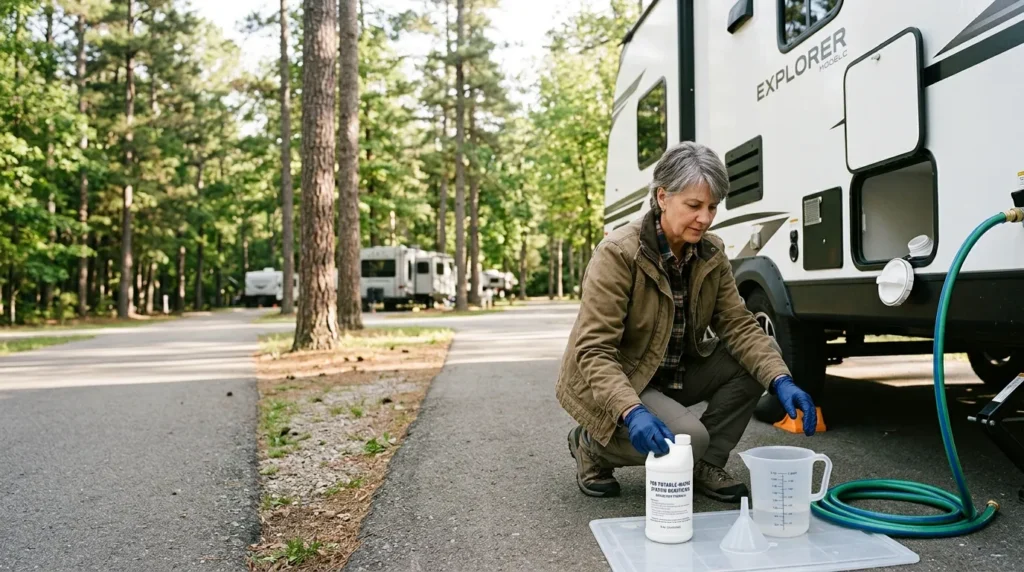
If you want to avoid chlorine odors in your RV’s water system, bleach isn’t always your only option. When someone asks me How To Sanitize RV Fresh Water Tank Without Bleach, I recommend checking the RV owner’s manual first, then choosing a hydrogen peroxide–based product specifically labeled for sanitizing potable-water tanks and plumbing. Household peroxide isn’t a direct substitute, so I wouldn’t guess at the amount or soaking time.
I also wouldn’t stop at cleaning the tank. The water lines, faucets, and shower need attention too, with the water heater and bypass components handled according to their manufacturers’ instructions. Follow the sanitizer’s dilution, contact-time, and flushing directions, and check that it’s compatible with your system. If sewage or other serious contamination is suspected, I’d get professional help before using the water.
What You Need Before Sanitizing an RV Water Tank
Before starting, gather the following:
- A hydrogen peroxide–based potable-water sanitizer or RV fresh-water tank sanitizer
- The product label and your RV owner’s manual
- A clean measuring container
- A potable-water hose
- A bucket or container for discharge water
- Fresh drinking water for rinsing
- Disposable gloves and eye protection
- A water-heater bypass, if your RV is equipped with one
- Replacement water filters, if the RV uses inline or canister filters
Use only a chemical that is labeled for use in drinking-water systems, potable-water tanks, or RV fresh-water systems. Do not assume that every bottle of hydrogen peroxide is suitable. Some products contain stabilizers, fragrances, dyes, or other ingredients that should not enter a drinking-water system.
Before applying any sanitizer:
- Park the RV on a level surface.
- Turn off the water pump and disconnect city water.
- Turn off the water heater and allow it to cool completely.
- Remove or bypass drinking-water filters.
- Confirm whether the RV manufacturer provides special instructions for the tank, plumbing, water heater, or filtration system.
- Open low-point drains and drain the existing tank and plumbing.
If the tank or plumbing may contain sewage, floodwater, fuel, antifreeze, algae, or another hazardous contaminant, do not rely on a routine maintenance procedure. A qualified RV service professional or public-health authority may be needed.
Why Hydrogen Peroxide Is Used Instead of Bleach
Hydrogen peroxide is an oxidizing agent. Under suitable conditions, it can damage or deactivate many microorganisms and then break down primarily into water and oxygen. That does not mean every concentration, product, or exposure time will reliably sanitize an RV water system.
The important distinction is between:
- A labeled potable-water sanitizer: Formulated and tested for a stated use, concentration, and contact time.
- Household hydrogen peroxide: Often sold at 3%, but the label may not authorize use in drinking-water tanks.
- Food-grade or industrial peroxide: May be highly concentrated and can cause serious burns or other injuries if improperly handled.
- Vinegar or citric acid: Useful for some mineral deposits and odors, but not a dependable substitute for a validated potable-water sanitizer.
The U.S. Environmental Protection Agency regulates antimicrobial products according to their label directions. The label specifies the organism claims, dilution, contact time, application method, and required rinsing. Those instructions take priority over generic online formulas.
Hydrogen peroxide also has limitations:
- It may not remove heavy mineral scale, biofilm, or sediment.
- Organic matter can reduce the effectiveness of some oxidizing treatments.
- A short exposure time may not be adequate.
- It can degrade during storage, especially when exposed to heat, light, or contamination.
- It should not be mixed with bleach, acids, ammonia, quaternary ammonium compounds, or other cleaners.
For routine RV maintenance, a labeled non-chlorine sanitizer is the most defensible choice. For suspected pathogenic contamination, use a product and procedure with documented potable-water directions rather than relying on an informal recipe.
How to Sanitize an RV Fresh Water Tank Without Bleach
The safest general procedure is to drain the system, isolate components that should not receive sanitizer, circulate the labeled solution through every potable-water fixture, hold it for the required contact time, and flush thoroughly.
1. Drain the existing water
Turn off the RV water pump and disconnect the city-water connection. Open the fresh-tank drain, low-point drains, and faucets to remove as much old water as possible.
Drain the water heater separately if the owner’s manual permits it. Never remove a water-heater drain plug or anode rod while the tank is hot or pressurized.
If the RV has a whole-house filter, remove the cartridge or install the manufacturer’s bypass. Sanitizer can damage some filter media, and a filter can also prevent the solution from reaching downstream plumbing.
2. Bypass the water heater when appropriate
Many RV manufacturers recommend bypassing the water heater during routine fresh-water tank sanitizing. This reduces chemical use and prevents the sanitizer from contacting components that may have separate maintenance instructions.
If the RV manual specifically instructs you to sanitize the water heater, follow that procedure instead. Some systems require a different concentration, temperature, or flushing sequence.
3. Prepare the sanitizer solution
Follow the sanitizer label exactly. Do not increase the concentration because “more must work better.” A stronger solution can damage materials, leave residue, create a safety hazard, or violate the product’s instructions.
For products sold as concentrates, use the label’s stated amount per gallon of tank capacity. For products sold ready to use, do not dilute unless the label directs you to do so.
Some RV guides and non-chlorine treatment products use 3% hydrogen peroxide in a measured ratio, but that ratio is not a universal standard. The correct amount depends on:
- The peroxide concentration
- Whether the product is stabilized or formulated for potable water
- The claimed microorganisms
- Required contact time
- Tank and plumbing materials
- Whether the solution must be flushed or neutralized
If the product has no potable-water label or does not state a dilution and contact time, choose a different product rather than guessing.
4. Add the solution to the fresh-water tank
Pour the prepared solution into the empty or partially empty fresh-water tank using a clean funnel. Add potable water according to the product directions until the solution is sufficiently diluted and the tank has enough volume to circulate through the plumbing.
Avoid pouring concentrated peroxide directly onto a dry tank or into a small plastic fitting. Diluting it before addition reduces the chance of localized material damage.
Close the tank drain and fill the tank to the level recommended by the sanitizer instructions. If the product requires the solution to reach all internal surfaces, the tank may need to be filled more completely.
5. Pressurize and circulate the solution
Turn on the RV water pump. Starting with the faucet closest to the tank, open each cold-water faucet until the sanitizer solution appears. Then close it and move to the next fixture.
Include:
- Kitchen faucet
- Bathroom faucet
- Shower
- Exterior shower
- Toilet sprayer, if equipped
- Ice-maker line, if connected to the fresh-water system
- Any other potable-water outlet
Operate each fixture long enough to replace the water in its branch line with sanitizer. Avoid drinking or using the solution.
If the water heater was included according to the RV manual, open the hot-water fixtures as well. Otherwise, keep the heater bypassed.
6. Observe the required contact time
Close all fixtures and let the sanitizer remain in the tank and plumbing for the time stated on the product label. Do not shorten the exposure because the tank appears clean or the solution has no odor.
Contact time is part of the disinfection process. Concentration alone does not establish that sanitizing has occurred.
Keep children and pets away from discharge points. Do not operate the RV water heater while the sanitizer is in the system unless the manufacturer and sanitizer instructions specifically allow it.
7. Drain the sanitizer
Open the tank drain, low-point drains, and faucets. Direct the discharge away from plants, ponds, storm drains, and areas where pets may drink. The product label may contain specific disposal instructions.
Do not assume that a peroxide solution is harmless to every plant, aquatic organism, or surface. Follow the label and local wastewater requirements.
8. Flush with fresh water
Refill the tank with potable water and run every fixture until the sanitizer odor or taste is gone. Drain the system and repeat the refill-and-flush cycle if necessary.
Pay attention to:
- Both hot and cold lines, if the heater was treated
- Exterior shower lines
- Toilet supply lines
- Ice-maker tubing
- Low-point drains
- Fixture aerators and showerheads
Replace water filters only after the final flush. If the water remains cloudy, has an unusual taste, or produces residue, drain and flush again rather than drinking it.
9. Verify the result
A successful routine sanitizing process should leave:
- Clear water
- No chemical odor or unusual taste
- No visible particles or slime
- Normal water pressure
- No persistent discoloration at faucets
A home water-quality test can provide additional information, but many basic test strips do not prove that an RV tank is microbiologically safe. If contamination is suspected, testing through a qualified laboratory is more meaningful than relying on appearance or odor.
Hydrogen Peroxide Amounts: How to Avoid a Dangerous Guess
The correct hydrogen peroxide amount depends on the product. Use this calculation only when the product label provides a target dose or concentration.
Required product amount = tank capacity × label dose per gallon
For example, if a product label specifies 2 fluid ounces per 10 gallons and the RV tank holds 40 gallons:
- 40 gallons ÷ 10 gallons = 4
- 4 × 2 fluid ounces = 8 fluid ounces of product
This is a hypothetical calculation, not a universal peroxide recipe.
RV tank capacity may be listed as 40 gallons, while the actual amount of water being treated is lower because of the tank shape, plumbing volume, or the level at which the owner chooses to fill it. When calculating, use the water volume specified by the sanitizer instructions.
| Situation | Recommended approach |
|---|---|
| Routine odor or scheduled maintenance | Use a labeled non-chlorine RV sanitizer |
| Unknown hydrogen peroxide concentration | Do not use it in the drinking-water system |
| Concentrated peroxide | Avoid unless the label specifically authorizes the use and you have suitable handling controls |
| Heavy sediment or scale | Clean and flush first; sanitizer is not a descaler |
| Suspected sewage or flood contamination | Use professional or public-health guidance |
| Product label conflicts with an online recipe | Follow the product label and RV manual |
A common mistake is converting a recipe intended for one peroxide concentration to another concentration without recalculating the active ingredient. A 3% solution and a concentrated commercial product cannot be measured by the same volume and expected to perform identically.
Can Vinegar, Citric Acid, or Baking Soda Replace Bleach?
Vinegar and citric acid should not be treated as automatic replacements for bleach or a labeled peroxide sanitizer.
Vinegar
Vinegar is an acid. It may help loosen some mineral deposits and can reduce certain odors, but household vinegar is not a validated universal disinfectant for an RV potable-water system. Its acidity can also affect seals, metals, and other components if used improperly.
Citric acid
Citric acid is commonly used for descaling and removing mineral deposits. It may be helpful after a water system has accumulated scale, but descaling and sanitizing are different tasks. A clean-looking tank is not necessarily microbiologically safe.
Baking soda
Baking soda may help neutralize odors or residue after cleaning, but it is not a primary sanitizer.
Combining cleaners
Never mix vinegar, citric acid, peroxide, bleach, ammonia, or other cleaning chemicals. Mixing products can create heat, irritating vapors, pressure, or hazardous chemical reactions.
If mineral scale is present, perform descaling as a separate procedure using a product and method approved for the specific RV plumbing system. Flush thoroughly before applying any sanitizer.
Common Problems After Sanitizing an RV Water Tank
The water still smells or tastes strange
Possible causes include:
- Incomplete flushing
- A contaminated water filter
- Residual sanitizer in a dead-end line
- A dirty faucet aerator or showerhead
- Biofilm or sediment that was not removed
- An odor originating from the water source rather than the RV
Remove and clean aerators, replace filters, drain the tank, and perform another fresh-water flush. If the odor persists, stop drinking the water and investigate the tank, hoses, heater, and source water.
The water is cloudy
Cloudiness may result from air, loose sediment, mineral deposits, or residue in the plumbing. Let a clear glass of water stand for several minutes. Bubbles that rise and disappear usually indicate entrained air; particles that settle or remain suspended require further investigation.
Drain and flush the system. If cloudiness continues, inspect the tank and filter housing.
Water pressure is lower after treatment
Check whether:
- The filter was reinstalled incorrectly
- A faucet aerator is clogged
- The pump strainer contains debris
- A low-point drain is partially open
- The pump is drawing air
- The city-water regulator or hose has restricted flow
Begin with the easiest checks: aerators, filter installation, and drain valves.
The tank develops an odor again quickly
Recurring odor can indicate:
- Stagnant water
- A contaminated fill hose
- Organic buildup
- Warm storage conditions
- A poorly cleaned water heater
- A source-water problem
Use a dedicated potable-water hose, drain the tank during long storage, keep the tank and plumbing dry when practical, and avoid leaving warm stagnant water in the system for extended periods.
The peroxide caused foaming
Some foaming can come from residual detergent, surfactants, or contamination in the plumbing. Peroxide itself is not a guarantee of a foam-free treatment. Drain the system and flush it with potable water. Do not add another chemical to suppress the foam.
Safety Rules for Non-Bleach RV Tank Sanitizing
Follow these boundaries:
- Do not drink sanitizer solution.
- Do not mix peroxide with bleach, vinegar, acids, ammonia, or other cleaners.
- Do not use concentrated peroxide without the correct label, equipment, and training.
- Do not operate the water heater during treatment unless the instructions allow it.
- Do not sanitize through an installed drinking-water filter unless the filter manufacturer permits it.
- Do not use an unverified internet recipe for a system connected to drinking water.
- Do not discharge treatment solution where children, pets, plants, or aquatic life may be exposed.
- Wear eye protection when measuring or handling concentrated products.
- Store chemicals in their original containers, away from heat and sunlight.
- Keep the RV owner’s manual available during the procedure.
If a person experiences eye exposure, skin burns, breathing difficulty, or ingestion, follow the product’s first-aid directions and contact Poison Control in the United States at 1-800-222-1222 or seek emergency medical care when appropriate.
How Often Should You Sanitize an RV Fresh Water Tank?
There is no single schedule that fits every RV. Sanitize the system:
- Before the first use of a new or winterized RV
- After long-term storage
- After filling from a questionable source
- After plumbing repairs
- When persistent odor, slime, or unusual taste develops
- According to the RV manufacturer’s maintenance instructions
Routine maintenance also matters. Use a clean, dedicated potable-water hose, keep the hose capped, avoid placing its end on the ground, and drain the tank when the RV will sit unused for an extended period.
Water quality at the source matters as well. A properly sanitized RV tank can become contaminated again through a dirty hose, unsanitary campground spigot, damaged filter, or improperly maintained water heater.
Frequently Asked Questions
Is hydrogen peroxide safer than bleach for an RV water tank?
Neither chemical is automatically safer in every situation. Hydrogen peroxide can be a suitable non-chlorine option when the product is labeled for potable-water use and handled correctly. Bleach remains a commonly documented RV sanitation method, but it can leave a chlorine odor or taste. The safest choice depends on the product label, RV materials, and the contamination involved.
Can I use 3% drugstore hydrogen peroxide?
Do not assume that ordinary 3% hydrogen peroxide is approved for use in an RV drinking-water system. Check the specific product label for potable-water authorization, ingredients, dilution, and contact time. If those details are absent, use a labeled RV or drinking-water sanitizer instead.
Do I need to sanitize the RV water heater?
Often, the water heater is bypassed during routine fresh-tank sanitation. However, the water heater can retain old or contaminated water. Follow the RV and water-heater manufacturer’s instructions, and never work on a hot or pressurized water heater.
How do I know when the tank is safe to drink from?
Clear water and the absence of odor are useful observations but do not prove microbiological safety. Follow the sanitizer’s complete procedure and flushing requirements. If the tank was exposed to sewage, floodwater, or another serious contaminant, use professional guidance or laboratory testing.
Can I sanitize an RV tank with peroxide and then use a carbon filter?
A carbon filter may reduce some tastes and odors, but it should not be used to compensate for an incomplete sanitation process. Flush the system first, then install a new or properly maintained filter according to the filter manufacturer’s instructions.
Final Recommendation
To sanitize an RV fresh water tank without bleach, choose a non-chlorine sanitizer labeled for potable-water or RV fresh-water systems, isolate filters and the water heater as directed, circulate the solution through every potable-water line, observe the full contact time, and flush until the water is clear and free of unusual taste or odor.
Do not substitute vinegar, citric acid, baking soda, or an unverified peroxide recipe for a validated sanitizer. When contamination is serious or the water remains questionable after treatment, stop using it for drinking and obtain qualified RV service or water-quality guidance.