

For an RV Fresh Water Tank Cleaner starts with checking what your RV manufacturer recommends—not simply picking the strongest product. In this guide, I explain how to choose an approved sanitizer and treat both the freshwater tank and its connected plumbing.
Plain, unscented household bleach is a common option, but the correct dose and contact time depend on its strength and your RV’s instructions. I also cover alternatives, including products specifically labeled for sanitizing RV freshwater systems. Not every cleaner removes biofilm, and an EPA registration alone does not mean a product is suitable for your tank.
My safety-first approach covers checking component compatibility, measuring accurately, allowing the required contact time, and flushing with potable water. I also explain why persistent odors or recurring contamination deserve investigation rather than repeated chemical treatments. Never mix bleach with other cleaners, and don’t rely on smell alone to judge water safety.

What Counts as an “RV Fresh Water Tank Cleaner” in the U.S.?
The phrase covers two needs:
- Cleaning: Removing sediment, scale, and odors.
- Sanitizing: Disinfecting the tank and plumbing so the water is safe to use for washing, cooking, and—if you choose—drinking.
In U.S. practice:
- Bleach-based sanitization is the standard for potable systems because it’s well studied, inexpensive, and compatible with RV plumbing when dosed correctly.
- EPA-registered drinking-water-system sanitizers (such as chlorine dioxide kits) are valid alternatives and can outperform bleach on biofilm.
- Vinegar, baking soda, and enzymatic “fresheners” can help with scale and odor but are not primary sanitizers for safe potable water.
- “Splashless,” scented, or thickened bleaches are not acceptable; use fresh, unscented, regular household bleach.
Key U.S. safety reference points:
- EPA Maximum Residual Disinfectant Level (MRDL) for free chlorine in drinking water: 4 mg/L (4 ppm).
- Typical RV sanitizing targets: 50–100 ppm free chlorine for 4–8 hours; up to 200 ppm for 1 hour when tackling heavy contamination. After contact time, flush until residual is at or near typical tap levels (ideally <1 ppm and definitely ≤4 ppm).
Step-by-Step: How to Sanitize Your RV Fresh Water Tank and Lines (USA Method)
Prerequisites
- Unscented household bleach (5.25–8.25% sodium hypochlorite), or an EPA-registered chlorine dioxide sanitizer per its label
- Drinking-water-safe hose (white/blue), clean funnel or winterize siphon
- Measuring cup, clean pitcher/jug for pre-dilution
- Nitrile gloves and eye protection
- Free-chlorine test strips (low range 0–10 ppm; optional high-range strips for shock)
- Access to your low-point drains and tank drain
- Filter bypass or removal of any carbon filter cartridge
Before you start
- Park level. Turn off the water heater (both electric and propane) and allow it to cool.
- If your RV has a carbon filter canister, remove the cartridge or bypass it; chlorine will destroy carbon and a wet carbon filter can harbor bacteria.
Steps
Drain and prep
- Drain the fresh tank and open low-point hot and cold drains. Open all faucets to speed draining.
- If you have sulfur/rotten-egg odor, also drain and flush the water heater tank. Bypass the water heater for the sanitizing soak to save disinfectant and reduce corrosion risk.
Mix the sanitizer
- For bleach: Calculate the dose (see the calculator section below). Pre-dilute the measured bleach in a few quarts of clean water so you never pour concentrated bleach directly into plastic.
- For chlorine dioxide: Follow the exact EPA-registered label; do not improvise concentration or contact time.
Add to the system
- Pour the diluted sanitizer into the tank via the gravity fill using a clean funnel. If filling via the city-water inlet, use the RV’s winterizing siphon or an inline mixer so the solution reaches the tank.
Fill and circulate
- Fill the tank with potable water.
- Turn on the pump and run each cold and hot faucet (including outdoor shower and toilet sprayer) until you smell chlorine at every outlet. Don’t forget the toilet valve.
Contact time
- Hold 50–100 ppm for 4–8 hours, or up to 200 ppm for 1 hour for heavy biofilm. Park in shade if possible. You can gently drive a few miles to slosh and help dislodge sediment.
Drain and flush
- Drain the tank and open all low-point drains.
- Refill the tank at least halfway and flush every outlet until chlorine odor mostly dissipates. Repeat until free chlorine is ideally below 1 ppm and definitely ≤4 ppm by test strip.
Restore and verify
- Take the water heater out of bypass, flush the heater tank, and reinstall/replace the anode rod as needed.
- Reinstall any filter cartridge (preferably new).
- Test residual chlorine at a faucet; if you’ll drink from the system, keep ≤1 ppm and ensure taste is neutral.
Signs of success
- No slimy film, earthy/barnyard or sulfur smell, or discoloration
- Free chlorine ≤4 ppm (preferably ≤1 ppm) after flushing
- Neutral taste and odor from the tap
If it didn’t work
- Repeat at 100 ppm for 4–8 hours or use an EPA-registered chlorine dioxide sanitizer per label directions.
- Persistent sulfur odor centered at the water heater often needs a heater-specific flush and possibly an aluminum/zinc anode replacement.
How Much Bleach to Use: Simple Formula and U.S.-Friendly Table
Target free chlorine and contact time
- Routine sanitizing: 50–100 ppm for 4–8 hours
- Heavy contamination/biofilm: 200 ppm for 1 hour (do not exceed routinely)
Use fresh, unscented, regular bleach. Old bleach loses strength. Always pre-dilute.
Quick formula (unscented household bleach)
- For 5.25% bleach: fl oz bleach = Gallons × Target ppm × 0.002438
- For 8.25% bleach: fl oz bleach = Gallons × Target ppm × 0.00155
- Cups = fl oz ÷ 8
Rule of thumb (common manual guidance, aligns with ~50–90 ppm): About 1/4 cup of 5–6% bleach per 15 gallons.
Example amounts (approximate)
- 50 ppm target
- 5.25% bleach: 0.122 fl oz per gallon
- 8.25% bleach: 0.078 fl oz per gallon
- 100 ppm target (double the above)
Sample table (rounded; use the formula for exact math)
| Tank size | 50 ppm @ 5.25% | 50 ppm @ 8.25% | 100 ppm @ 5.25% | 100 ppm @ 8.25% |
|---|---|---|---|---|
| 20 gal | 2.4 fl oz (~1/4–1/3 cup) | 1.6 fl oz (~1/5 cup) | 4.9 fl oz (~0.6 cup) | 3.1 fl oz (~0.4 cup) |
| 30 gal | 3.7 fl oz (~0.45 cup) | 2.3 fl oz (~0.3 cup) | 7.3 fl oz (~0.9 cup) | 4.7 fl oz (~0.6 cup) |
| 40 gal | 4.9 fl oz (~0.6 cup) | 3.1 fl oz (~0.4 cup) | 9.8 fl oz (~1.2 cups) | 6.2 fl oz (~0.8 cup) |
| 50 gal | 6.1 fl oz (~0.75 cup) | 3.9 fl oz (~0.5 cup) | 12.2 fl oz (~1.5 cups) | 7.8 fl oz (~1.0 cup) |
| 80 gal | 9.8 fl oz (~1.25 cups) | 6.2 fl oz (~0.8 cup) | 19.0 fl oz (~2.4 cups) | 12.4 fl oz (~1.6 cups) |
| 100 gal | 12.2 fl oz (~1.5 cups) | 7.8 fl oz (~1.0 cup) | 24.4 fl oz (~3.1 cups) | 15.5 fl oz (~1.9 cups) |
Tip: After sanitizing, flush until free chlorine is preferably ≤1 ppm. Optional: neutralize residual chlorine taste with a Campden tablet (potassium metabisulfite) sized for your volume, then flush lightly.
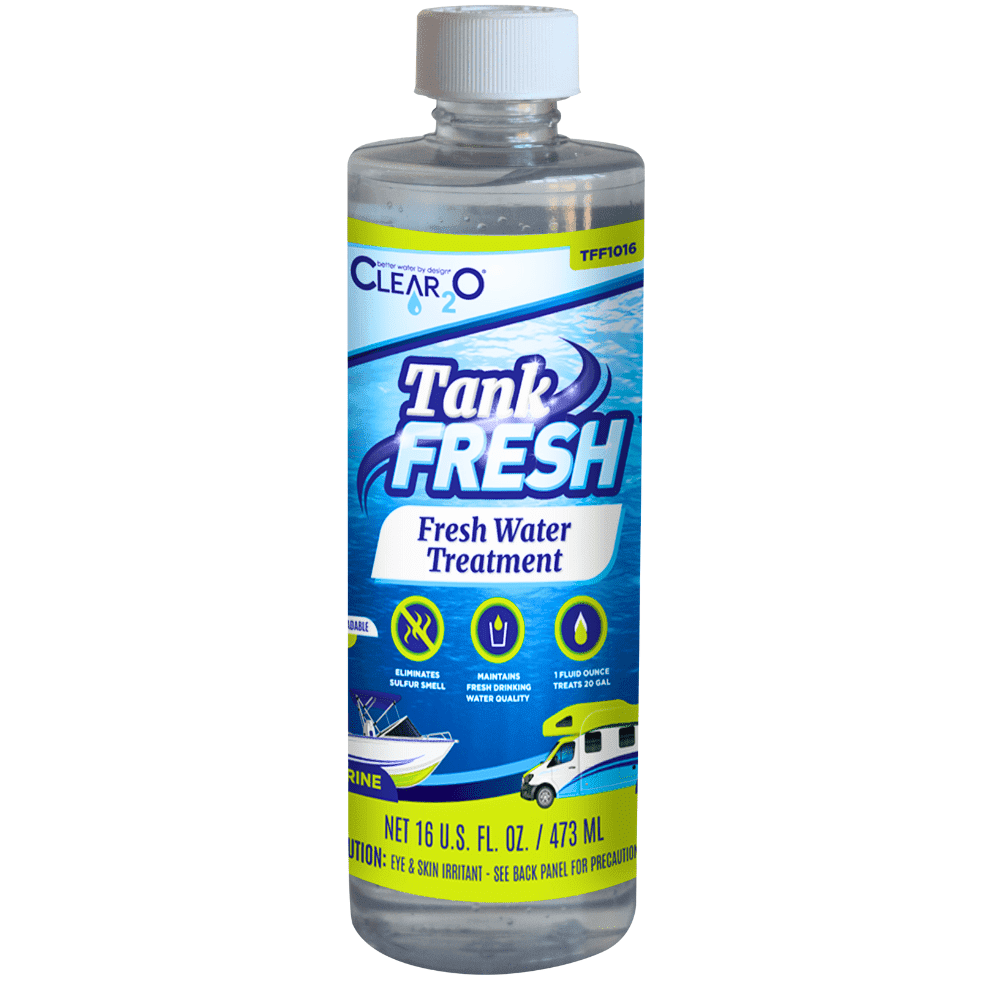
Alternatives to Bleach: When They Make Sense
- EPA-registered chlorine dioxide kits
- Pros: Excellent against biofilm, effective at lower taste/odor impact, leaves minimal residual.
- Use: Follow the product’s EPA label exactly for drinking-water-system sanitization. Good choice when bleach taste lingers, slime persists after bleaching, or sensitive users dislike chlorine.
- Hydrogen peroxide (food/USP grade, properly diluted)
- Pros: Breaks down to water and oxygen; helps with certain odors.
- Limits: Less reliable than bleach or chlorine dioxide against established biofilm at practical RV concentrations and contact times. Consider as a deodorizing rinse, not a primary sanitizer, unless the product is specifically labeled for potable systems.
- Vinegar (acetic acid)
- Pros: Dissolves mineral scale and can reduce musty odors.
- Limits: Not a stand-alone potable water sanitizer. Never mix with bleach.
- Peracetic acid formulations (often with hydrogen peroxide)
- Pros: Strong sanitizer used industrially.
- Limits: Only use products specifically labeled for drinking-water-system sanitization; follow the label. Many surface sanitizers are not approved for potable systems.
Decision tip: For a true “RV fresh water tank cleaner” that also sanitizes to U.S. potable standards, stick to correctly dosed bleach or an EPA-registered chlorine dioxide kit. Use vinegar or peroxide only as adjuncts for scale/odor, not as sole sanitizers unless the product is certified for drinking water systems.

Troubleshooting Bad Tastes, Odors, and Slime
Symptoms and likely causes
- Rotten egg/sulfur smell, especially on hot side: Bacteria interacting with a magnesium anode in the water heater; stagnant water.
Fix: Drain heater, flush, sanitize lines, consider aluminum/zinc anode replacement; avoid prolonged heater bypass after sanitizing. - Earthy/musty taste or slime (biofilm): Infrequent sanitizing, warm storage, old carbon filter.
Fix: 100–200 ppm shock (per method), or chlorine dioxide per label; replace filters and sanitize before installing new ones. - Plastic/chemical taste: New hoses/tanks or over-chlorination residuals.
Fix: Several full fresh-water flushes; run water through all taps; brief neutralization with a Campden tablet if needed. - Yellow/rusty water or sediment: Mineral-rich source water or tank debris.
Fix: Drain via tank and low points; gently drive to agitate, then drain again; add a sediment prefilter at the spigot.
Persistent problems after proper sanitizing
- Sanitize again with chlorine dioxide per label.
- Inspect and clean the tank vent, gravity-fill cap, and city-water check valve screen.
- Replace old vinyl lines or a compromised tank if contamination recurs quickly.
- If you draw from a U.S. private well, have the well water tested and shock-chlorinated per local health department guidance.

Maintenance Schedule and Preventive Practices for U.S. Campgrounds
Recommended cadence
- Sanitize at least every 6 months, and:
- After storage or de-winterizing
- After any questionable fill (unknown spigot, boil-water advisory, or flood event)
- Whenever you detect odor, slime, or off-taste
Preventive tips
- Use a drinking-water-safe hose, and cap hose ends between uses; sanitize hose ends periodically (brief 200 ppm dip).
- Pre-filter campground water: sediment (5–20 micron) before the RV, and a carbon block inside if you prefer better taste (replace on schedule).
- Keep tank dry during long storage; crack drains and run the pump dry for a second to empty low spots (don’t run dry for more than a moment).
- Track dates of sanitization and filter changes.
- Avoid leaving water stagnant in heat; cycle water regularly during summer travel.
For drinking from the RV tank
- Keep residual chlorine low (≤1 ppm at the tap) and use a fresh 0.5-micron carbon block after sanitizing.
- Immunocompromised users may prefer bottled water for drinking and use the RV system for washing and cooking only.
Common Mistakes and Safety Limits
- Using scented or splashless bleach: These contain additives; use only unscented regular bleach.
- Guessing bleach strength: Check the label (5.25–8.25% are common). Old bleach loses potency—adjust or replace.
- Over-chlorinating for too long: High chlorine for extended periods can degrade seals. Stay within 50–100 ppm for 4–8 hours or 200 ppm for 1 hour, then flush.
- Forgetting the heater bypass and carbon filter: Bypass the heater during the soak; remove/bypass carbon filters until after flushing.
- Mixing chemicals: Never mix bleach with vinegar, ammonia, or anything except clean water.
- Drinking before flushing: Do not consume until residual chlorine is ≤4 ppm (preferably ≤1 ppm) and taste is acceptable.
- Ignoring local advisories: In the U.S., respect boil-water notices and campground guidance; sanitize after any advisory is lifted.
Evidence-Led Product Shortlist (Non-Promotional)
Use products that match these characteristics:
- Unscented, regular household bleach, 5–8.25% sodium hypochlorite
- Label should state the percentage; avoid splashless, scented, or gel.
- EPA-registered drinking-water-system sanitizer (chlorine dioxide kits)
- Bottle/box must show an EPA Reg. No. and potable system directions. Follow label concentration and contact time precisely.
- Free-chlorine test strips
- One pack with low range (0–10 ppm) and, optionally, a few high-range strips for verifying shock concentrations.
- Drinking-water-safe hose and replacement washers
- White/blue hose labeled for potable water; keep ends clean and capped.
- Sediment and carbon filters with stated micron ratings
- Replace on schedule; sanitize system before installing a new carbon block.
FAQs
How often should I sanitize my RV fresh water tank in the U.S.?
At least every 6 months, and after storage, any suspected contamination, or foul taste/odor. Many U.S. RVers sanitize at the start of the season and mid-season.
Is bleach safe for RV plumbing?
Yes, at 50–100 ppm for 4–8 hours (or 200 ppm for 1 hour) followed by a thorough flush. Don’t use scented/splashless bleach. Prolonged high concentrations can damage seals.
Can I drink from my RV tank after sanitizing?
Yes, after flushing to ≤4 ppm residual chlorine (preferably ≤1 ppm) and confirming neutral taste. Many travelers still use bottled water for drinking out of preference.
Do I have to sanitize the water heater?
Bypass it during the soak to save sanitizer, but drain and flush the heater separately. If hot-water odors persist, sanitize the heater and consider an aluminum/zinc anode.
Will vinegar sanitize my RV tank?
No. Vinegar can help with mineral scale and some odors but is not a primary potable water sanitizer. Use bleach or an EPA-registered chlorine dioxide product for sanitizing.
Conclusion
For U.S. RVers, the safest and most cost-effective fresh water tank cleaner is a correct sanitizing routine: dose fresh, unscented bleach to 50–100 ppm (or use a labeled chlorine dioxide kit), hold for the proper contact time, and flush to safe residual levels. Back it with good hose hygiene, timely filter changes, and a twice-yearly schedule, and your RV’s water will stay clean, clear, and confidence-inspiring.